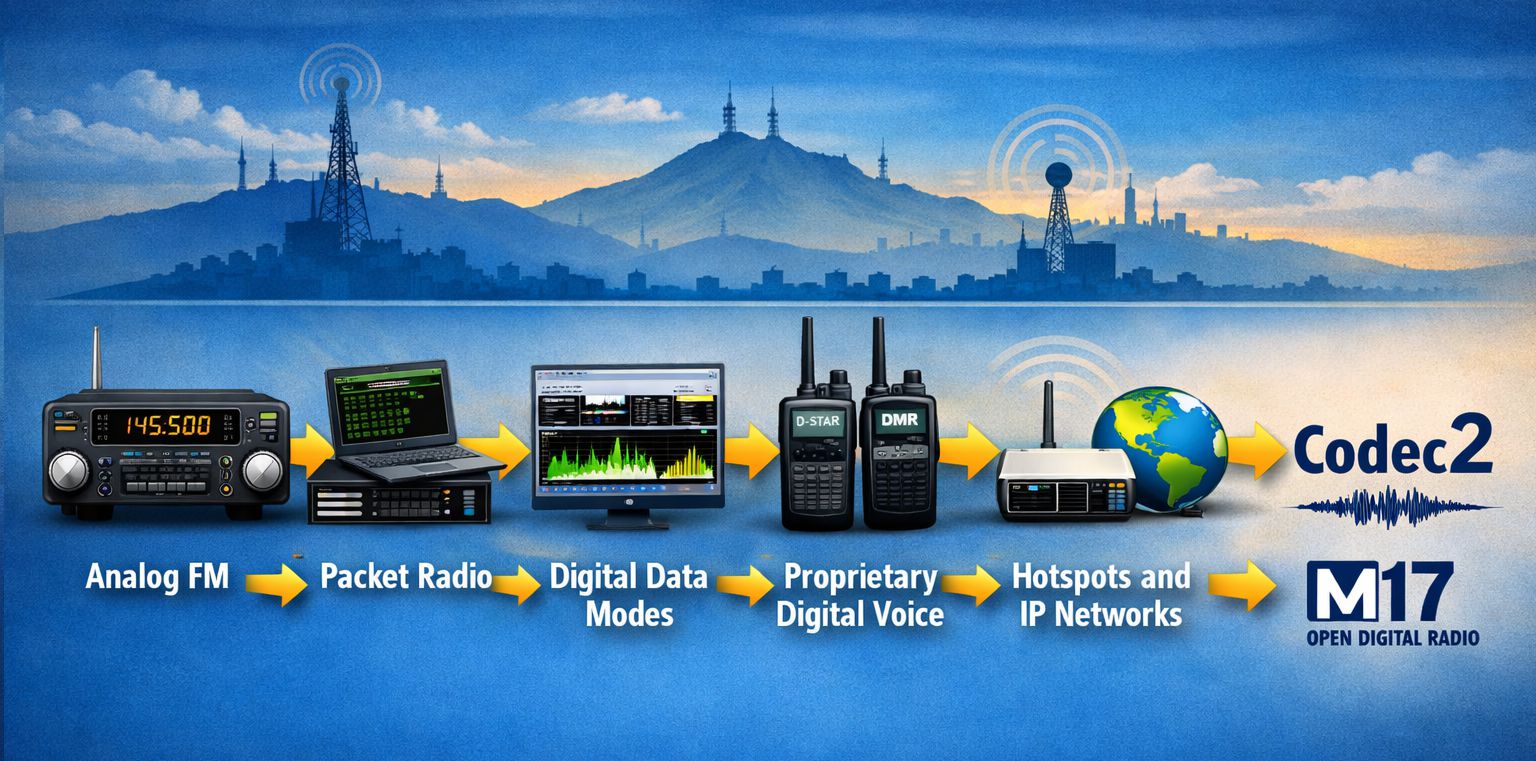
Digital Voice
Digital voice has become a daily reality in the amateur radio world: increasingly advanced VHF and UHF transceivers, Internet-connected repeater networks, and systems capable of integrating voice, data, and operator identification. But behind the simple press of a PTT button lies a much deeper transformation than it might appear.
For this reason, I decided to create a new section of the website dedicated to digital voice in amateur radio, exploring its history, its technology, and above all the design choices behind the different systems currently in use.
The starting question is simple: what really happens when the voice, instead of directly modulating a radio carrier, is transformed into a stream of data? The answer inevitably leads to concepts such as sampling, compression, voice codecs, error correction, network protocols, and the integration between radio frequency systems and IP infrastructures.
The series begins with the evolution of digital communications and goes on to analyse the main VHF/UHF digital voice systems: D-STAR, C4FM/System Fusion, DMR, and M17, highlighting not only their technical differences, but also the different philosophies that shaped their development.
However, the central theme of this series is not to determine which system is the “best”.
Every technology is the result of compromises between openness, ease of use, performance, adoption, and the possibility of experimentation. Digital voice carries an interesting contradiction: it was born in an environment – amateur radio – historically based on experimentation and knowledge sharing, yet it often relies on fundamental components, especially voice codecs, developed according to proprietary and therefore essentially closed models.
This is precisely the paradox of digital voice: a technology that makes communication more efficient and powerful, but that in some cases hides essential parts that are not freely accessible. Fortunately, the amateur radio community is also addressing this challenge, with remarkable projects such as M17 and Codec2.
The goal of this section is therefore not to provide yet another operational guide on how to configure a transceiver, but rather to understand what lies behind the technology we use every day. Because knowing how a system works also means being able to make more informed choices, understand its limitations, and appreciate the ideas that led to its creation.
If you are interested in digital radio, its evolution, and the increasingly close relationship between radio frequency engineering and computer science, I hope this journey will provide some interesting insights.
Enjoy the reading.
The series is available in the site’s Digital Voice section.
Share this content:
Post Comment