The Fundamental Principle
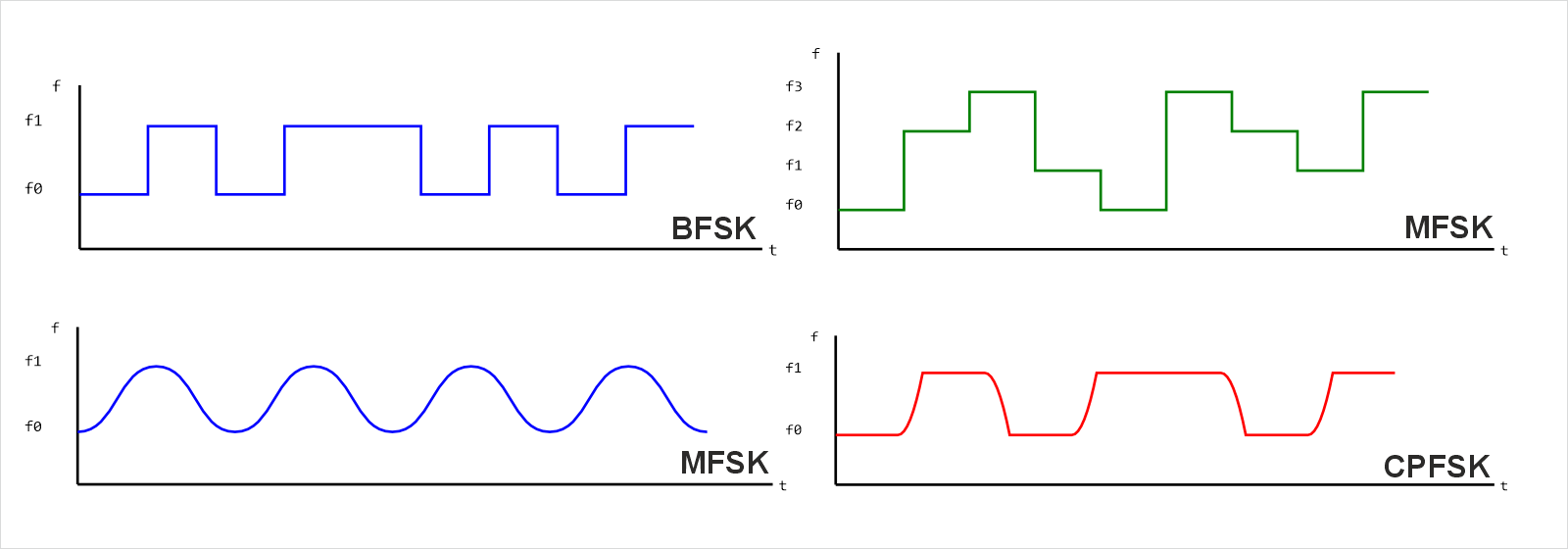
FSK modulation (Frequency Shift Keying) is one of the most widely used techniques in digital radio communications, particularly in amateur radio. Its principle is conceptually simple: instead of varying the amplitude or phase of the signal, the frequency of the carrier is changed to represent digital data. The information is not carried by “how much” or “how” the signal oscillates, but by which frequency is used at a given moment.
In the most basic case, called BFSK (Binary FSK), exactly two distinct frequencies are used: one for the “0” bit (space) and one for the “1” bit (mark). This approach is robust, simple to implement, and historically resilient under poor propagation conditions, which is why it was adopted in early radio teleprinter systems.
RTTY: the Historical Application
The most classic digital mode based on FSK is RTTY (Radioteletype). In amateur HF communications, the difference between the two frequencies—called the shift—is typically 170 Hz, although in other contexts (e.g., historical commercial systems) shifts of 425 or 850 Hz were used. The principle remains valid regardless of the numerical values.
By established convention, the mark frequency is always the higher of the two RF frequencies. When referring to an RTTY station frequency, one always means its mark frequency. This convention is important for interoperability between stations.
RTTY, despite being an old technology, is still widely used today thanks to its reliability and ease of decoding even under poor signal conditions. It requires no complex algorithms or precise time synchronization: it is enough to receive alternating tones.
FSK or AFSK? Two Paths to the Same Result
In practical station operation, there are two distinct ways to generate an RTTY signal: direct FSK and AFSK. The received signal is perceptually identical in both cases—you always hear alternating tones, the classic RTTY sound—but the transmission method is very different.
Direct FSK
In “pure” FSK, the radio itself switches between two transmission frequencies. The transmitter does not remain fixed on a single frequency but rapidly toggles between two closely spaced values, driven directly by the synthesizer stage or VFO via a digital signal from a computer or teleprinter. No audio stage is involved: the signal is generated directly at RF.
The result is a very stable, well-defined signal free from distortions that can be introduced by an audio chain. Moreover, operating in native FSK/RTTY mode allows the use of narrow IF filters (typically 250 or 500 Hz), a significant advantage in crowded bands. For this reason, in well-equipped stations—especially in contest environments—direct FSK is often preferred: it occupies less actual bandwidth and produces a cleaner spectrum.
The practical limitation is that not all radios support a dedicated FSK input, and the setup typically requires a serial interface or dedicated hardware, making it less straightforward.
AFSK
AFSK (Audio FSK) was developed as a more accessible solution. In this case, the radio frequency is not directly manipulated: the computer generates two distinct audio tones—traditionally 2125 Hz (mark) and 2295 Hz (space), exactly 170 Hz apart—which are fed into the microphone or line input of the radio set to LSB (Lower Side Band).
Here a non-intuitive but important detail comes into play: lower sideband SSB inverts the relationship between audio frequency and RF frequency. The higher audio tone (2295 Hz, space) becomes the lower RF frequency, while the lower audio tone (2125 Hz, mark) becomes the higher RF frequency. In this way, the RTTY convention—mark being the higher RF frequency—is automatically preserved. If USB were used instead of LSB, the tones would be inverted, making communication incompatible with other stations.
From the perspective of the transmitted signal, the result is remarkably similar to direct FSK: two RF frequencies spaced by 170 Hz. The difference lies in the signal path: AFSK passes through a full audio chain (sound card, levels, internal radio filtering), which introduces some practical issues:
- if the audio level is too high, distortion is introduced;
- if it is too low, the signal becomes weak;
- the radio’s speech processor must be disabled, or it will distort the signal;
- VOX users must be careful: any computer sound—notifications, system alerts—may accidentally trigger transmission.
On the other hand, AFSK is extremely convenient: with just an audio interface, virtually any SSB transceiver can be used for RTTY and many other digital modes.
As with FSK, an AFSK signal is still demodulated back to audio on reception: what is heard is always just alternating tones. There is no practical way, by listening alone, to distinguish whether a signal was generated using FSK or AFSK.
Variants of the FSK Family
Binary FSK is only the starting point. Over time, more advanced variants have been developed, each with specific characteristics and applications.
MFSK – Multiple FSK
Instead of using only two frequencies, MFSK uses a larger set. Each transmitted tone represents a symbol that encodes multiple bits: with 4 tones, 2 bits per symbol are encoded; with 8 tones, 3 bits per symbol, and so on. Compared to binary FSK, the advantage is better spectral efficiency and improved resilience to noise and fading, since the multiple orthogonal tones can be individually discriminated by narrow filters, reducing the impact of noise. This is typically combined with FEC (Forward Error Correction), further improving robustness.
The most significant representatives of MFSK in amateur radio are Olivia, Thor, and—in an evolved form—FT8.
Olivia is the most widely used MFSK mode in HF for communications under poor conditions. It uses a configurable number of tones (typically 8, 16, or 32) over selectable bandwidths (250, 500, or 1000 Hz). The most common starting configuration is Olivia 8/250, while Olivia 16/500 and 32/1000 are used for longer conversations once the link is established. Its decoding threshold is significantly lower than RTTY: Olivia can decode signals at approximately −14 dB SNR (relative to bandwidth), meaning that in many cases the signal is not perceptible to the human ear but still correctly decoded by software. This makes it especially suitable for long-distance paths, polar or auroral fading, and low-power communication.
Thor is an MFSK mode developed as a direct evolution of MFSK16, with important design differences: it uses more sophisticated symbol interleaving to combat frequency-selective fading and slightly different tone spacing. Like Olivia, it comes in multiple speed variants (Thor8, Thor16, Thor22, etc.), allowing a trade-off between speed and robustness. Thor is generally considered slightly faster than Olivia under similar conditions, but less robust in extreme cases.
FT8 represents the opposite extreme in terms of automation and decoding threshold, and is described in more detail elsewhere.
CPFSK – Continuous Phase FSK
A limitation of basic FSK is that when the signal switches between frequencies, a phase discontinuity may occur if the phase is not aligned. This discontinuity generates unwanted spectral emissions, widening the occupied bandwidth.
CPFSK (Continuous Phase FSK) solves this by enforcing phase continuity during transitions: the frequency changes, but without phase “jumps.” The result is a much more compact and cleaner spectrum, with reduced out-of-band emissions. Although this may seem like a theoretical detail, it has practical implications in spectral efficiency and coexistence with other users.
A special case of CPFSK with modulation index 0.5 is MSK (Minimum Shift Keying), considered the narrowest possible bandwidth variant. From this derives GMSK (Gaussian MSK), which applies a Gaussian filter before modulation to further smooth transitions: it is used in GSM networks and many modern digital radio systems.
FSK and the Doppler Effect
A relevant aspect in certain operational contexts, such as low-Earth orbit (LEO) satellite communications, is the Doppler effect: relative motion between transmitter and receiver causes a frequency shift in the received signal. In FSK systems, this results in a shift of the entire tone set, which can move signals outside receiver filters unless compensated. Systems operating in such environments require active Doppler correction. It is worth noting that MFSK16—and by extension Olivia and Thor—are inherently more tolerant to Doppler than PSK31 due to their non-coherent demodulation.
Contemporary Applications
Packet Radio
Packet radio (based on the AX.25 protocol) uses a form of AFSK, typically at 1200 baud on VHF, with 1200 Hz (mark) and 2200 Hz (space) tones according to the Bell 202 standard. On UHF, 9600 baud FSK is often used instead. This approach has the advantage of requiring relatively simple hardware: an audio interface and a TNC (Terminal Node Controller) are sufficient for most applications.
FT8 and Weak Signal Modes
FT8 is not strictly classical FSK, but rather a significant evolution of it. It uses 8-tone modulation (GFSK – Gaussian FSK) with 6.25 Hz tone spacing, 15-second time-synchronized transmissions, and LDPC (Low-Density Parity-Check) channel coding, enabling decoding at extremely low SNR levels (typically down to −20 dB). The goal is to maximize successful decoding probability even when the signal is not perceptible: in this case, modulation design is inseparable from digital signal processing and error correction algorithms.
In Summary
The FSK family of modulations represents an effective balance between simplicity, robustness, and spectral efficiency. From early radio teleprinters to modern weak-signal modes, these techniques remain one of the pillars of amateur radio communications.
There is no universally best choice: direct FSK offers the cleanest and most compact signal and is preferred where technical quality is the priority. AFSK is more flexible and accessible and is the most common solution in modern computer-based stations. MFSK variants—such as Olivia and Thor in amateur radio—further extend the design space, optimizing the trade-off between speed, bandwidth, and noise resilience.
Conceptually simple frequency switching techniques have proven capable of evolving and remaining relevant even in the era of advanced DSP—and they will likely continue to do so.
 Info
InfoAFSK tones 2125/2295 Hz derive from the Bell 202 standard adapted for RTTY; the 170 Hz shift is specific to amateur HF operation.
The relationship between CPFSK, MSK, and GMSK is well established in signal theory literature.
FT8 uses LDPC error correction integrated into the WSJT-X protocol.
Olivia and Thor are implemented in fldigi and other major amateur digital mode software packages.