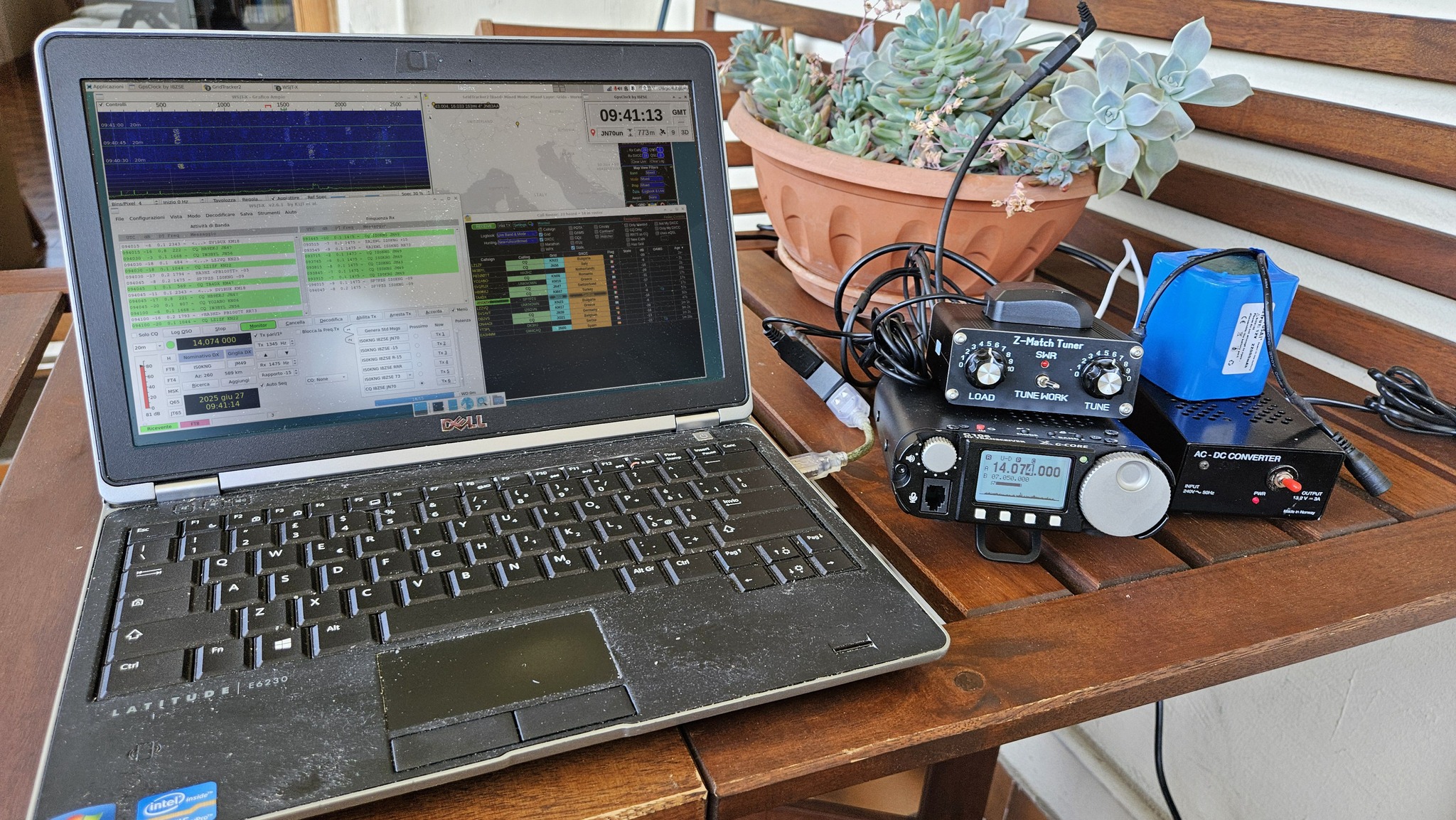
On this page I want to share my way of putting together an essential and low‑cost radio station, a configuration that closely reflects the one I use for my mobile activity. It has no advertising purpose: the equipment mentioned is the result of my personal choices, explained in the text, and serves only as a starting point for reflection for those who want to navigate the sea of available options.
The goal is to offer a practical path for those approaching amateur radio, setting aside hype, trends and long‑held beliefs that often confuse more than they help. Here we talk about numbers, technical logic, and how to build something effective without major investments.
I have deliberately chosen a QRP solution as a starting point. In my opinion, it is the most sensible approach for beginners: it allows you to truly learn how radio “breathes”, costs less, simplifies many operational choices and, above all, allows you to experiment safely, avoiding the most common misunderstanding about power. The reality is that watts are not the decisive element in most situations, as I will explain later in the text.
What follows is not a recipe, but a guide: a way to understand what you really need to get started, to evaluate each component critically, and to build a station that makes sense for your needs, not for current trends.
QRP: power is not everything
The power of a radio is often perceived as the main parameter when choosing a transceiver, almost the definitive metric to distinguish a serious radio from a limited one. It’s a common and understandable reflex: power is a simple, immediate, reassuring number. In mainstream amateur radio culture, 100 watts are considered the bare minimum.
For this reason, radios with power around 10 watts (QRP) are sometimes perceived as a kind of diminutio capitis, a fallback choice, as if operating with low power meant doing less radio, or a weaker, less authoritative, less effective radio. In reality, it’s the exact opposite: QRP is not a reduced version of amateur radio, but a more technical, more conscious practice focused on the quality of the entire chain, not just the final amplifier.
Those who operate QRP do not give up radio: they give up the shortcut of power, replacing it with design, antenna care, attention to propagation and the pleasure of experimentation. The real diminutio, if any, concerns only the number of watts; certainly not the skills, satisfaction or quality of the amateur radio experience.
With only a few watts you don’t have the brute force that compensates for mediocre antennas or compromised installations. Instead, you have the obligation – and the pleasure – to take care of every detail of the chain. This is why many operators discover that working QRP means first of all working with better, more efficient and better‑positioned antennas. And often, thanks to this attention, QRP works surprisingly well. A significant boost has come from FT8 and, more generally, from weak signal technologies, which have greatly expanded the horizons of QRP.
The numbers must also be contextualized. The ratio between 100 W and 10 W is 10 dB; in reception, one S‑unit is about 6 dB. With the same installation, this means losing just over one and a half S‑units on the other side: an S9 signal becomes S7+, still more than adequate for a phone QSO. By optimizing the system – cables and antenna – the result can improve without difficulty. Of course, it’s not the ideal setup for DX in SSB, but if the goal is to have fun, it works perfectly.
There is another aspect that often goes unnoticed until you start operating QRP: everything else becomes cheaper, lighter and much safer for experimentation.
With a few watts, cables can be thin, light and inexpensive; baluns, tuners and ununs can be home‑built without risking saturation or overheating; dummy loads cost a few euros and are easy to make; wattmeters can be simple low‑power instruments; batteries and power supplies are small and cheap. You can try strange antennas, borderline configurations, improvised solutions… without fear of breaking anything.
QRP, in short, opens a dimension of freedom that medium power does not allow so easily. With a 100‑watt radio you must always worry about current draw, proper sizing, and the risk of damaging tuners, baluns, connectors or finals. In QRP, instead, you experiment freely: mistakes cost little and cause no damage.
It is clear, however, that in terms of QSO reliability, QRP is not the same as 100 watts: in phone it requires patience, in digital it works surprisingly well, and in CW it excels. But the decisive aspect remains one: if the antenna is excellent, QRP performs surprisingly well; if the antenna does not work, nothing can compensate for those few watts.
For many amateurs, this combination – low power, well‑designed antennas, inexpensive equipment and total freedom to experiment – represents the purest and most rewarding form of technical amateur radio. Not because it is better, but because it leads to truly understanding how radio works. And when you want, you can always move to medium power by adding a simple booster; but with the awareness of someone who already knows how to get the most out of a single watt.
Comparing radios
Choosing a radio is objectively difficult, with an extremely wide range of options, and each of us has our own evaluation criteria. In the past, word of mouth prevailed; today we have the Internet, which often provides conflicting information. Rather than relying on reviews – which reflect subjective impressions and individual experiences – it is more sensible to base the choice on numbers. I refer to measurable key parameters: those declared by the manufacturer are a first reference, but even better are independent measurements performed by specialized laboratories such as ARRL or Sherwood Engineering, which offer objective and comparable data.
It is worth remembering that the receiving side is far more important than the transmitting side: you can have a kilowatt in the antenna, but if you cannot hear the other station, the QSO will not happen. Receiver quality, sensitivity and selectivity are therefore decisive parameters, often more important than output power.
Another element not to overlook is operational simplicity. QRP radios, by their nature, are compact and have little room for direct controls. This results in an essential interface that may seem limiting, but actually encourages the operator to focus on the essentials, reducing complexity and promoting a more conscious approach to amateur radio. Sometimes, as we will see, too many options can become a problem.
The parameters
As mentioned, the main parameters to evaluate – those that give an overall view of receiver performance – are the following:
| Parameter | Technical meaning | Practical impact |
| Sensitivity | Ability of the receiver to detect weak signals above noise. | Allows decoding QSOs even with few watts; essential for weak‑signal and digital modes (FT8, JT65). |
| Noise floor (MDS) | Minimum signal level distinguishable from internal noise. | The lower the noise floor, the more marginal signals become audible. Essential for exploiting propagation and borderline signals. |
| Blocking dynamic range | Receiver resistance to strong signals near the listening frequency. | Prevents strong signals from crushing weak ones. Crucial in contests, crowded bands or urban environments. |
| Mixing dynamic range | Influence of local oscillator phase noise on weak signals near strong ones. | Ensures clean reception even in the presence of nearby strong stations. Improves QSO quality in real‑world scenarios. |
Sensitivity: measures the receiver’s ability to distinguish weak signals from noise. It is normally expressed in microvolts (μV), more rarely in dBm. It depends on bandwidth: in CW, with narrow filters, sensitivity is better than in AM, which uses wider filters. Values must therefore be compared mode by mode.
Noise floor: represents the minimum signal level perceivable as such by the receiver. The lower it is, the “quieter” the receiver.
Dynamic range: indicates the receiver’s ability to handle weak signals in the presence of strong signals on nearby frequencies. It includes two values: Blocking, which measures the ability not to degrade in the presence of strong signals; and Mixing, which evaluates how much internal noise affects the reception of weak signals near strong ones. Good dynamic range is essential in crowded bands or areas with high operator density.
Transmitter parameters
| Parameter | Technical meaning | Practical impact |
| Output power | RF power available at the antenna connector. | More power means stronger signal, but with non‑linear gain: 3 dB for each doubling. |
| Spurious and harmonic suppression | Ability of the transmitter not to generate unwanted out‑of‑band signals. | Critical for regulatory compliance and avoiding interference; lower values indicate cleaner transmission and less wasted energy. |
| Intermodulation (IMD) | Evaluates transmitter linearity. | Low IMD means clearer modulation and less distortion. |
Output power: is the most immediate parameter, but not the most important. Knowing that a radio outputs 5, 10 or 100 watts is useful, but what really matters is that the power is stable, linear and clean. In QRP, where power is low, signal quality becomes even more important.
Spurious and harmonic suppression: every transmitter produces unwanted signals. Harmonics are multiples of the fundamental frequency, while spurious emissions may fall in completely different bands. Good suppression is essential to operate correctly and avoid interference.
Intermodulation (IMD): measures signal “cleanliness”. High IMD means voice or CW distortion and unwanted products. Low IMD corresponds to a more pleasant, intelligible and less intrusive signal.
For portable operators, an important parameter is current consumption, especially in receive. Lower values increase battery autonomy.
Features
There are also additional features to consider. A non‑exhaustive list:
- VOX (Voice Operated Transmission): automatically switches to transmit with voice (SSB) or key (CW), without pressing PTT. Useful for hands‑free operation.
- Speech processor: processing system that makes modulation more “robust”, increasing intelligibility.
- Keyer: facilitates the use of paddles in CW, automatically generating dots and dashes.
In practice
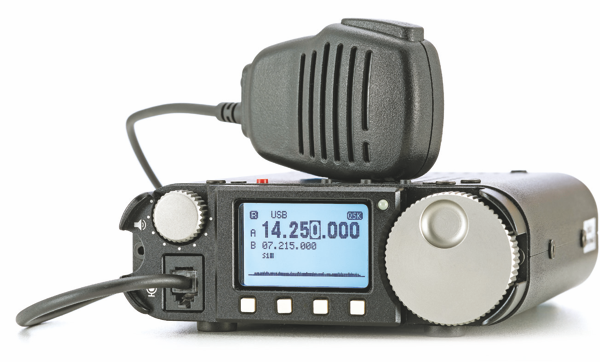
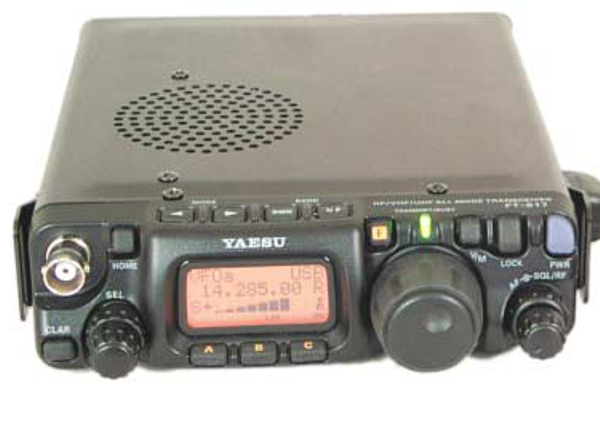
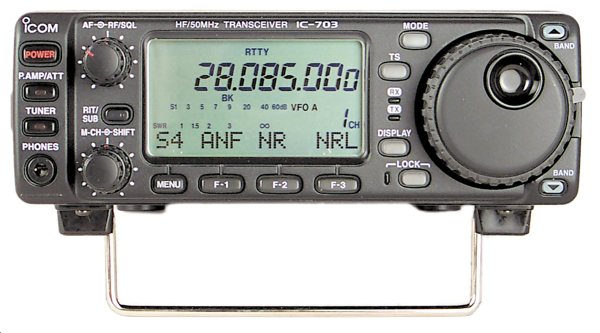
This is a comparative table for some QRP or entry‑level radios I have owned over time. The data is homogeneous and all refers to the 20m band (14 MHz).
As you can see, despite covering a very wide time span, the numbers are not very different in the end.
| Parameter | Xiegu G106 (2022) | Yaesu FT‑817 (2001) | Icom IC‑703 (2003) | Yaesu FT‑747GX (1987) |
| Sensitivity (MDS/MDR) | ~0.3 µV (–127 dBm) | ~0.25 µV (–131 dBm) | ~0.2 µV (–132 dBm) | ~0.25 µV (–131 dBm) |
| Noise floor (SSB) | –127 dBm | –131 dBm | –132 dBm | –131 dBm |
| Blocking factor (2 kHz) | ~94 dB | ~90 dB | ~95 dB | ~95 dB |
| Mixing dynamic range | ~70 dB | ~72 dB | ~74 dB | ~70 dB |
| TX spurious | –40 dBc | –45 dBc | –50 dBc | –40 dBc |
| TX IMD (3rd order) | –28 dB | –30 dB | –32 dB | –30 dB |
| RX current | ~0.32 A | ~0.45 A | ~0.6 A | ~1.2 A |
| TX current | <2 A | ~2 A | ~3 A | ~20 A |
| Output power | >5 W | 5 W | 10 W | 100 W |
| Notes | Entry‑level SDR, FM broadcast RX | Multiband HF/VHF/UHF QRP | HF+6m, built‑in ATU | Classic entry‑level HF |
 |
 |
 |
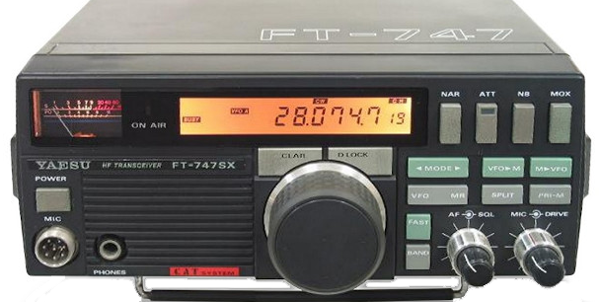 |
A version of the FT‑747 also existed called SX, with 10 W output power.
In what follows I will refer to the G106, which is the radio I currently use for mobile activity, and which is at the moment the most economical complete transceiver on the market.
There are, however, even cheaper alternatives, such as uSDX or TruSDX SDR, although they do not cover the entire HF spectrum.
Obviously, the choice does not depend solely on measurement results; many other factors come into play, not least the feeling that often develops toward a particular product.
I’ll add one final consideration. Older radios all have physical controls, usually with one or two functions at most. More modern radios have progressively moved functions previously handled by buttons into setup menus. These menus have grown richer over time, and even base‑station radios now include hundreds of configuration items. 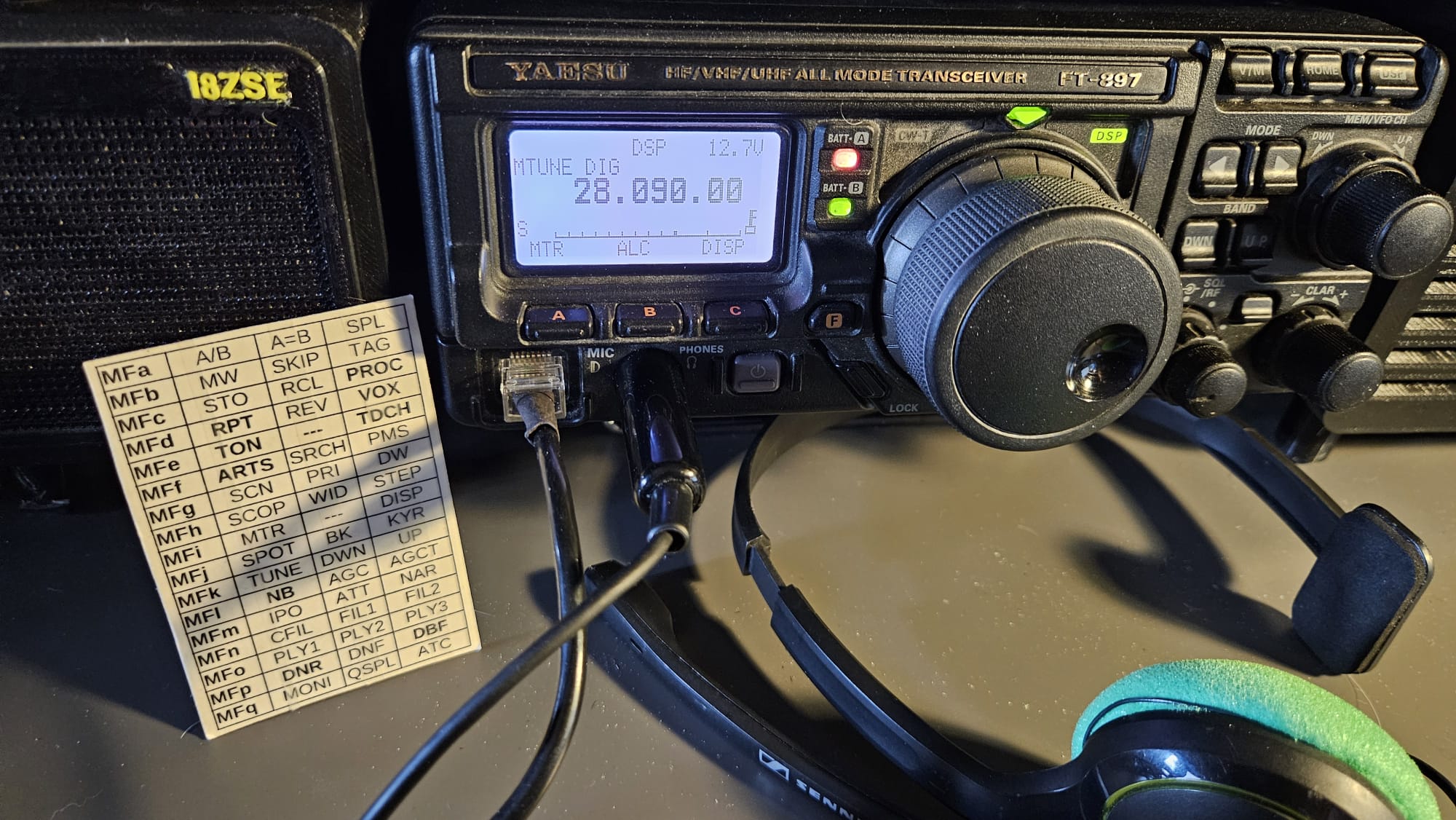
In addition, QRP radios – which are usually compact, and therefore have little room for controls – solve the problem by assigning many functions to the same few buttons. The downside is that often, even just to check whether a certain function is active or not, you must scroll through lists of menu items before reaching the right one.
It’s an inevitable approach, but it makes the radio more complex to operate and can create problems during a critical contact.
In these cases, I create a small reference sheet listing the submenu combinations; the photo shows the one for the three function keys of the FT‑897, another good entry‑level radio. To these, you must add the 92 menu items.
It is often assumed that having a radio with many functions is always an advantage, but for beginners this is not the case. A simple transceiver, with few controls and a minimal menu, allows you to focus on the essentials: listening, transmitting, and understanding how the radio behaves in real conditions.
This direct approach helps develop both the ear and manual skill, without getting lost among dozens of menu items or multifunction buttons that are rarely used.
On the contrary, a feature‑rich radio can become dispersive: complexity risks turning into an obstacle, slowing learning and making the experience less intuitive.
For this reason, especially at the beginning, operational simplicity is often more valuable than a wealth of features.