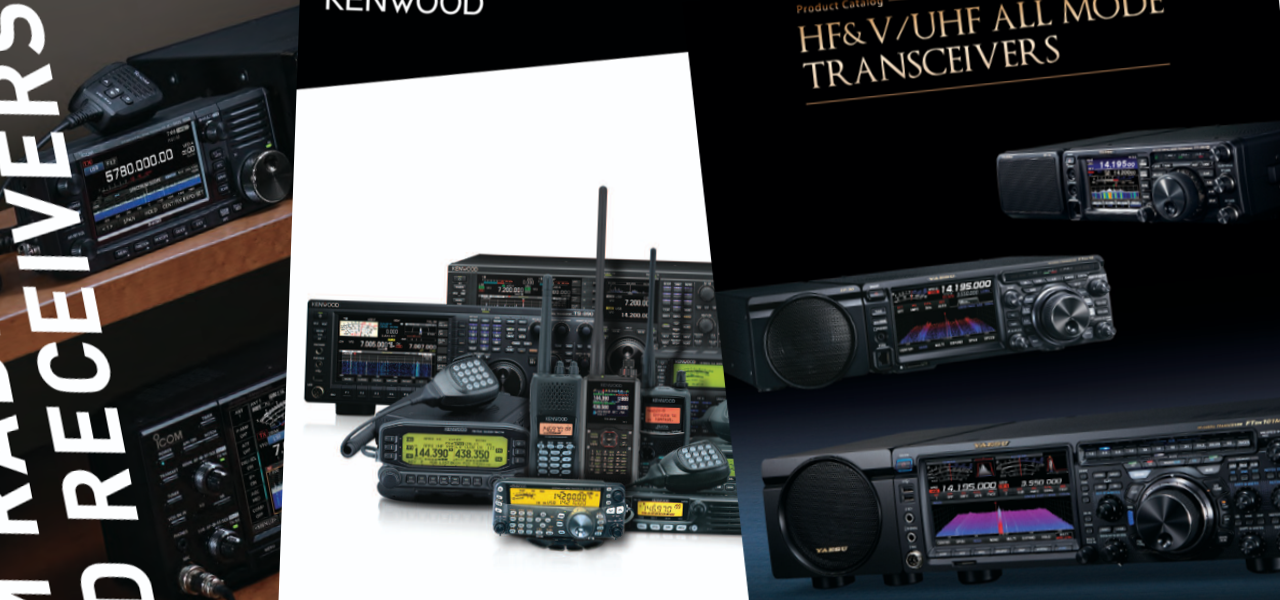
The Heart of the Station: Choosing the Right Radio
As we’ve seen, the radio transceiver is truly the heart of any amateur radio station — and thus deserves careful consideration according to the operator’s goals and, of course, their budget.
The market offers a wide range of new models as well as a very active second-hand ecosystem, which can be both a blessing and a source of confusion, especially for newcomers.
Here I’ll share my personal point of view on what I consider to be the most important aspects to evaluate, in order to provide a more objective way to compare different radios.
I should emphasize that all of these reflections are strictly personal: this space contains no advertising — neither direct nor disguised.
This overview refers specifically to HF (High Frequency) equipment, which is usually the most fascinating range for those entering the world of amateur radio.
Architecture
The traditional superheterodyne design, despite being nearly a century old, remains a benchmark in receiver architecture.
The incoming RF (radio frequency) signal is converted through one or more mixing stages to one or more fixed intermediate frequencies (IF), where most of the amplification and filtering occur.
SDR (Software Defined Radio) transceivers, on the other hand, represent a major paradigm shift, moving much of the signal processing from the analog to the digital domain.
After minimal analog conditioning, the RF signal is digitized and then processed entirely in software.
The advantages of SDR architecture lie in its flexibility, upgradeability, and the ability to monitor wide portions of the spectrum simultaneously.
However, real-world performance still depends on implementation quality, as both architectures have specific strengths and limitations.
Sensitivity
When evaluating radios, I always prioritize the receiver section, since it’s the most crucial: you must first hear the other station before you can work it.
The main specification is sensitivity, or the ability to detect very weak signals.
A sensitive receiver can discern faint signals even when they’re close to the background noise level.
This concept relates directly to the signal-to-noise ratio (S/N) — like hearing a whisper in a quiet room versus trying to listen in heavy traffic.
Sensitivity is therefore linked to the receiver’s ability to maintain a good S/N ratio with very low-level signals.
Another important factor is bandwidth: the wider it is, the more noise passes along with the signal.
Narrower bandwidths reduce noise and improve sensitivity — but if the filter is too narrow, part of the signal itself is lost.
For CW (Morse) operation, narrow filters yield excellent performance, while AM (Amplitude Modulation) requires wider filters, which naturally collect more noise.
In summary, a receiver’s sensitivity depends on:
- the minimum signal level it can discern;
- the S/N ratio at that level;
- the effective filter bandwidth.
Sensitivity is usually expressed in microvolts (µV) or dBm, and comparisons are meaningful only when bandwidth conditions are equivalent.
Selectivity
Selectivity is the ability to separate signals that are close in frequency — a crucial factor in crowded band conditions.
Specifications usually list bandwidths at –6 dB (where attenuation becomes significant) and –60 dB (where adjacent signals are effectively suppressed).
The closer these values are to the nominal filter bandwidth, the better the selectivity.
Dynamic Range
Another critical specification — especially for contesters and DXers — is dynamic range, or the receiver’s ability to handle strong off-frequency signals without distorting weak ones.
Key elements include:
- Blocking Dynamic Range (BDR): ability to receive weak signals in the presence of strong out-of-band signals;
- Third-Order Intercept Point (IP3): a measure of receiver linearity and resistance to intermodulation distortion.
Dynamic range is fundamental but often omitted from commercial datasheets.
Independent test data — such as those published by Sherwood Engineering — are therefore invaluable for objective comparison.
Frequency Stability
Frequency stability is crucial in both receive and transmit paths.
It’s particularly critical for digital modes, where even a few Hz of drift can prevent proper decoding.
Modern radios using DDS or PLL synthesizers already perform well, but many offer the option to install a TCXO (Temperature Compensated Crystal Oscillator) for further improvement.
Transmitter Section
In transmission, besides output power — typically 100 W for HF rigs — key parameters include:
- Harmonic suppression, or how effectively unwanted frequency multiples are filtered out;
- Spectral purity, ensuring the transmitted signal is free of spurious emissions and intermodulation products.
A transmitter with good harmonic and spurious suppression produces a clean signal, minimizing interference to others.
Other Considerations
Among secondary yet useful aspects:
- the ability to use the radio as a general coverage receiver, spanning from longwave up through 30 MHz;
- the user interface and menu system: modern radios integrate DSP, memories, equalizers, and digital features, often through deep menu trees.
Older analog or hybrid radios offer fewer features but more direct, tactile control — something many operators still appreciate.
In Conclusion
From the numbers and user experience alike, it’s clear there’s no universally superior architecture.
Traditional superheterodyne rigs excel in robustness and large-signal handling, while SDRs shine in flexibility, spectrum visualization, and software evolution.
When comparing radios from different eras or technologies but within the same class, you’ll often find that overall performance remains remarkably close.
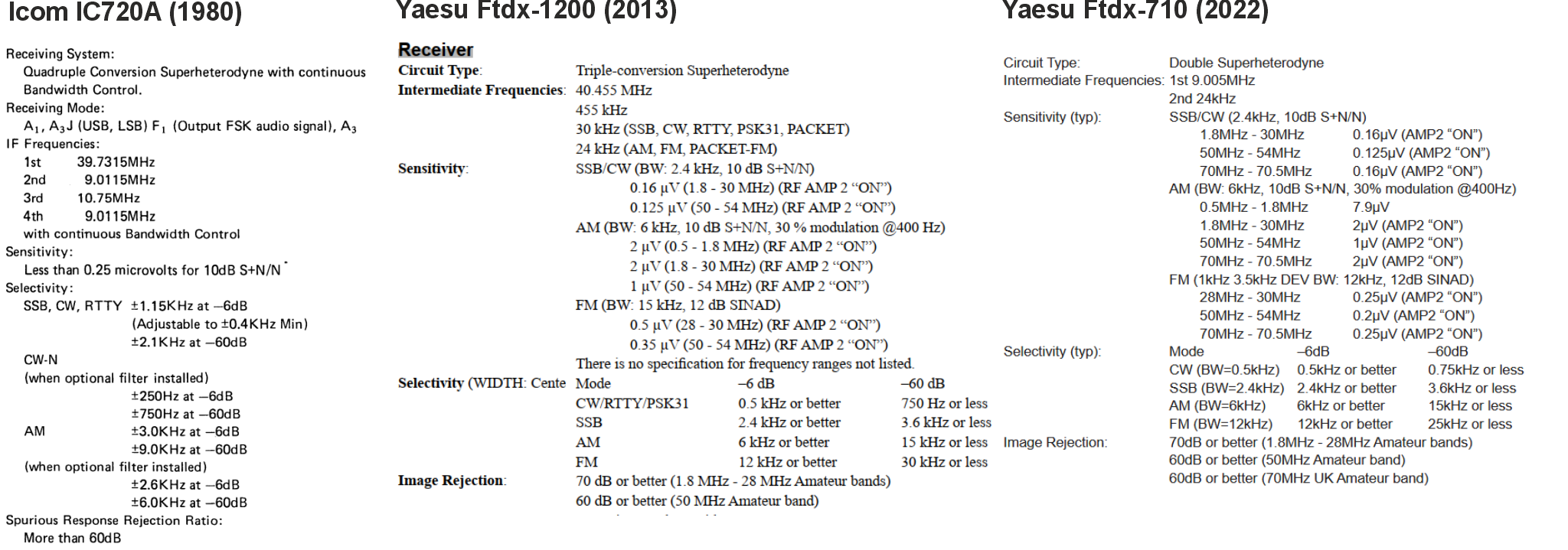
A deep understanding of the technical specifications allows you to make an informed, objective decision — but ultimately, operator skill and antenna quality remain the most decisive factors for success on the air.