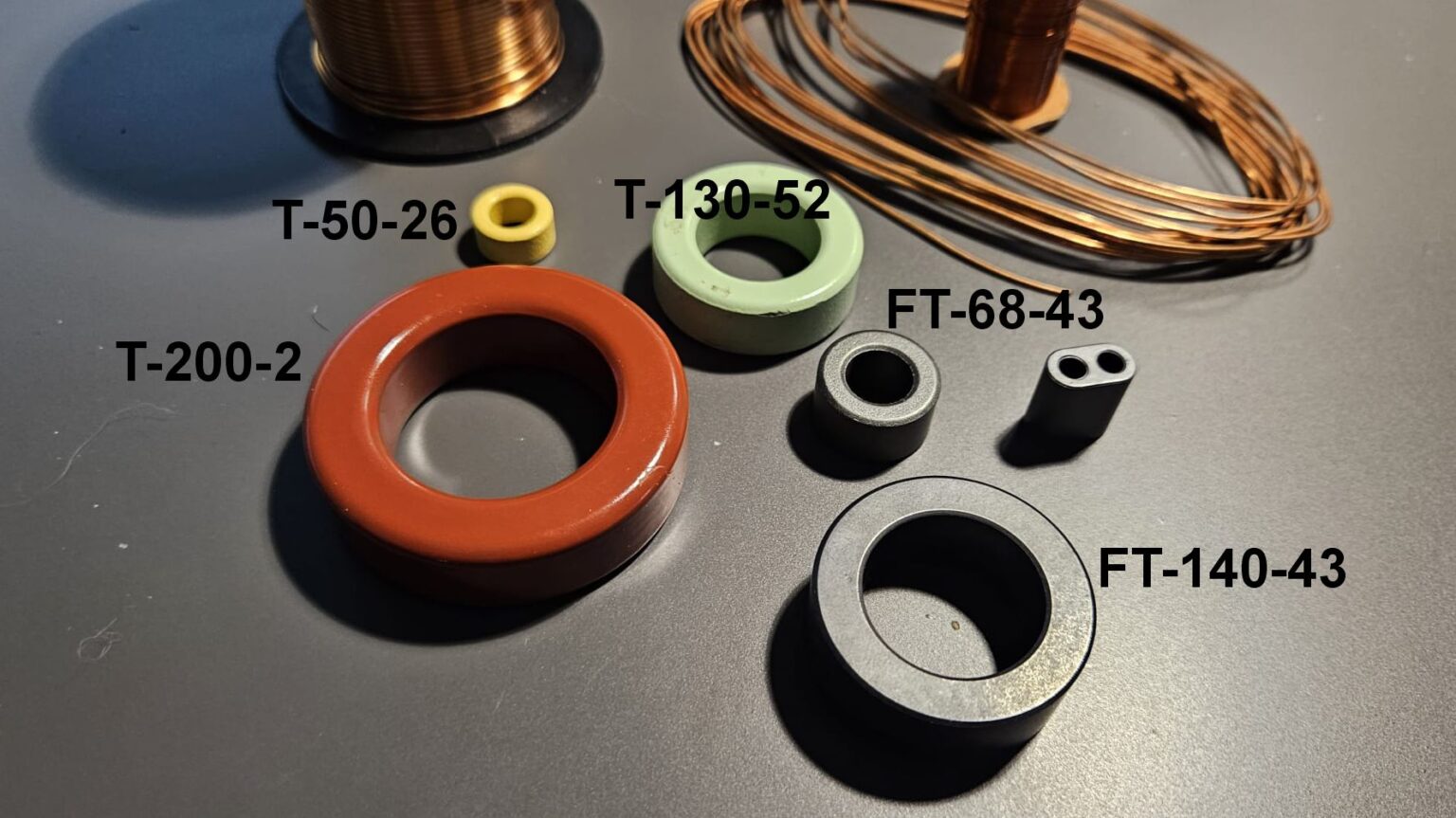
Toroids
In our ham radio world, toroids are fundamental components, yet they are often poorly understood. You will find them in transformers, baluns, ununs, filters, antenna tuners, power supplies (and the list could go on), and they almost always play a critically important role. Their strength lies in their shape: a ring that closes the magnetic flux upon itself, reducing leakage and interference. This characteristic makes it possible to build inductors with a high quality factor (Q) and maintain stable performance even when multiple toroids are mounted close together.
Another reason amateur radio operators appreciate them is their compactness: a small number of turns can produce significant inductance, making toroids ideal for HF filters, impedance transformers, and matching circuits. Not surprisingly, they are widely used up through the VHF bands thanks to the large variety of ferromagnetic mixes available.
Perhaps the most interesting and often underestimated aspect concerns the antenna system. A good antenna is not simply “a wire that radiates”; it is a system in which you must decide where current should flow and where it should not. Common-mode current, for example, is one of the main causes of noise, radiation pattern distortion, and SWR problems. This is where toroids become invaluable tools: they allow the construction of chokes, baluns, and ununs that guide current along the desired path, preventing it from returning on the coaxial cable or spreading along unwanted structures. Thanks to them, a long-wire antenna can be matched from 400–600 Ω down to 50 Ω using a 9:1 unun, or a balun can operate stably across multiple bands (provided the correct mix is chosen, avoiding, for example, using a T-200-2 as though it were universal, since its permeability is very low).
In other words, toroids are not just used to create inductance; they ensure that current flows where it should, when it should, and in the manner we want. They are tools of control, order, and cleanliness within the antenna system.
Ferrites: High-Permeability Materials for RF and Suppression
Ferrites are ceramic materials composed of iron oxides combined with other metals. Their most notable characteristic is their very high permeability, which allows significant inductance to be achieved with only a few turns. This makes them ideal for common-mode chokes, broadband transformers, and EMI suppression filters.
Their nomenclature follows the format FT-xx-yy, where xx represents the outside diameter in hundredths of an inch and yy identifies the mix (31, 43, 61, and so on). The mix is a code that specifies the material composition used in the core and determines its physical characteristics. The most common mixes are:
- Mix 31 is designed for the lower HF bands and broadband suppression applications, typically from 1 to 300 MHz (with maximum effectiveness between 1 and 30 MHz).
- Mix 43 is one of the most widely used. It performs well from 1 to 50 MHz and provides an excellent compromise for HF chokes and transformers.
- Mix 61 exhibits lower losses at higher frequencies and is mainly used between 200 MHz and 1 GHz, making it suitable for VHF/UHF applications.
- Mix 75, with extremely high permeability (μi ≈ 5000), is suitable for filters and suppression applications below 1 MHz.
Ferrites do have a limitation: as frequency increases, losses rise rapidly. For this reason, above a certain frequency range, more stable materials are generally preferred.
Iron Powder Cores: Low-Permeability Materials for High-Q Inductors
Iron powder toroids are quite different. The material is not ceramic but consists of metallic particles insulated from one another and compressed into a toroidal shape. Their permeability is much lower than that of ferrites, but losses at higher frequencies are reduced and thermal stability is excellent. This makes them ideal for power inductors, HF and VHF low-pass filters, and high-efficiency transformers.
Their nomenclature follows the format T-xx-yy, where xx represents the outside diameter in hundredths of an inch and yy identifies the mix. For example, T-50-2 indicates a toroid with an outside diameter of 0.50 inches (approximately 12.7 mm) using Mix 2 material.
These mixes are often identifiable by color:
- Mix 2 (red): widely used in HF applications (2–30 MHz), ideal for low-pass filters and high-Q inductors.
- Mix 6 (yellow): excellent for VHF applications (40–100 MHz), with very low losses.
- Mix 26 (yellow/white): designed for power inductors and switching filters (1–10 MHz).
- Mix 52 (green/white): a good compromise for robust and stable HF inductors.
Unlike ferrites, where color coding is often absent or arbitrary, the color of an iron powder core directly identifies the mix being used.
Two Families, Two Different Behaviors
In summary, ferrites and iron powder cores address different requirements:
- Ferrites provide high inductance and are ideal for transformers and chokes, especially when broadband operation or interference suppression is required.
- Iron powder cores prioritize stability and low loss, making them the natural choice for power inductors and high-efficiency filters.
The choice of mix is therefore not a minor detail-it is the heart of the magnetic design. A broadband balun typically requires Mix 31 or 43; an HF low-pass filter generally favors Mix 2; a VHF inductor performs best with Mix 6; and a switching filter typically requires Mix 26 or 52.
Share this content:
Post Comment