Combining Amplitude and Phase
APSK modulation (Amplitude and Phase Shift Keying) is one of those ideas that emerges when it becomes clear that neither amplitude nor phase alone is sufficient anymore. It is the meeting point between ASK and PSK: a modulation that combines discrete amplitude variations with discrete phase variations to achieve very dense, highly efficient, and surprisingly robust constellations. If QAM is the “queen” of digital modulations, APSK is its cousin engineered for harsh channels—those where linearity is not guaranteed and power is not unlimited.
The core idea is simple to describe: instead of arranging symbols on a Cartesian grid like QAM, APSK places them on concentric rings, each containing a certain number of equally spaced phase points. Each ring represents an amplitude level, while the angular position represents phase. It is a “target-like” constellation designed to better tolerate non-ideal amplifiers and channels that distort amplitude more than phase.
Why APSK Exists
QAM is very efficient, but it requires an extremely linear channel: a small amount of amplifier compression is enough to distort the constellation, shift points, and increase errors. APSK was created precisely to address this issue—by distributing symbols in a more “tolerant” way, reducing sensitivity to amplitude distortion while still maintaining high spectral efficiency.
The concentric-ring structure allows better control over symbol spacing, optimizing the constellation for the expected channel noise and distortion. It is a modulation particularly favored in satellite systems, where linearity is never perfect and power is a scarce resource.
What an APSK Constellation Looks Like
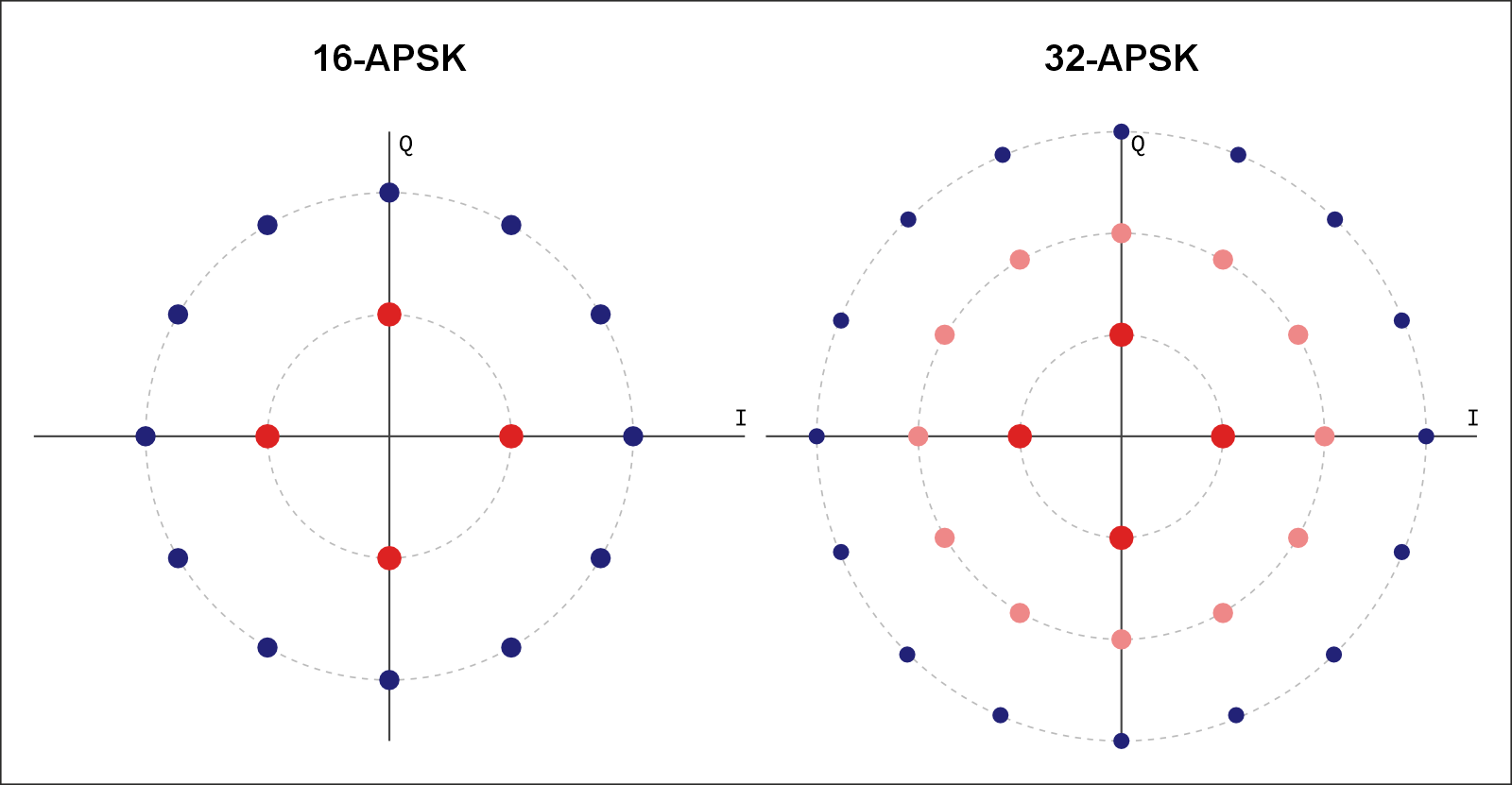
Unlike QAM, which has a grid structure, APSK has a radial structure. A typical example is 16-APSK, with two rings—one inner ring with 4 points and an outer ring with 12 points.
32-APSK uses three rings, with a 4 + 12 + 16 distribution across inner, middle, and outer rings. The ratio between ring radii is not fixed: in DVB-S2 it varies depending on the applied code rate, because the goal is always to maximize minimum symbol distance under expected channel conditions. In this sense, the constellation is literally “tailored” to the channel.
Visually, on a constellation diagram, APSK is very elegant: concentric circles with evenly spaced points, like a digital mandala.
APSK and Amateur Radio
In amateur radio, APSK is not a “common” modulation like PSK31, FT8, or QAM in wideband systems. However, it appears in several interesting contexts, especially for those experimenting with SDRs, satellites, and advanced modulation schemes.
Satellites and DVB-S2
The most important case is the satellite world. The DVB-S2 standard, also used by radio amateurs for digital transponders and for links in S, C, and Ku bands, employs APSK modulations (16-APSK, 32-APSK) because they offer an excellent trade-off between spectral efficiency and robustness over nonlinear channels. The standard was later extended in DVB-S2X, introducing even higher orders such as 64-APSK and 128-APSK, still maintaining the concentric-ring structure. For those experimenting with modern SDR receivers, this evolution opens very interesting analysis possibilities. Operators working with linear transponders or digital beacons from amateur satellites may already have encountered APSK—sometimes without realizing it.
SDR and Experimentation
With an SDR, APSK becomes a fascinating playground. It allows the generation of complex constellations, observation of how rings deform under amplifier nonlinearity, direct comparison between APSK and QAM, and experimentation with synchronization and equalization algorithms.
It is a modulation that clearly highlights the gap between theory and practice: even mild compression is enough to see outer-ring points “collapse” inward.
Low-Power and Microwave Applications
In some experimental microwave projects—especially for narrowband digital links—APSK is chosen precisely for its tolerance to distortion. It is not as common as FSK or PSK, but it is a reasonable choice when efficiency must be pushed without requiring perfect linearity.
Advantages and Limitations of APSK
APSK is a compromise modulation. It is more efficient than pure PSK, more robust than QAM at the same order, and more tolerant to nonlinearities—but it does not reach the maximum efficiency of the most aggressive QAM constellations, nor does it completely remove linearity requirements. It is worth clarifying this: modulations like QPSK or 8PSK can operate close to satellite transponder saturation, whereas 16-APSK and 32-APSK still require some power back-off. The advantage of APSK lies in allowing higher spectral efficiency even when linearity is imperfect, not in eliminating this constraint.
Its strength is flexibility: the constellation can be “shaped” to fit the channel by adjusting ring ratios and symbol distribution according to the code rate and expected conditions.
This is why it is widely used in satellite systems, where every decibel matters and perfect linearity is never available.
APSK on the Waterfall and in Practice
Observing an APSK signal on a waterfall is not as intuitive as ASK or FSK: its structure is not immediately visible, since the modulation combines amplitude and phase simultaneously. However, when analyzed through a constellation diagram, the ring structure becomes immediately clear. It is one of the best ways to understand how the channel distorts the signal: rings become elliptical, points shift, and symmetry breaks. This is a very useful exercise for learning how to read digital signals at a deeper level.
In Summary
APSK is a modulation that combines amplitude and phase into a radial constellation designed for efficiency and tolerance to nonlinearities. It is less common than QAM in terrestrial systems but essential in satellite communications and highly relevant for SDR experimentation and advanced modulation studies. For amateur radio operators, it represents a step toward professional-grade modulation schemes—those that must work even when the channel is imperfect and power is limited.
It is an elegant, engineering-driven modulation, and a clear example of how constellation geometry can be adapted to the channel in order to extract the maximum possible performance from every hertz and every watt.