ASK Modulation: Amplitude as a Switch
ASK modulation, Amplitude Shift Keying, is probably the simplest possible way to turn a sequence of bits into a radio signal.
It is, in a sense, the digital version of AM: instead of shaping the carrier according to an analog signal, the carrier is simply made to appear or disappear depending on the bits to be transmitted. It is a primitive, almost naïve idea, but precisely for this reason it is extremely easy to understand. If AM is a continuous sculpting of amplitude, ASK is a switch: on, off, on, off.
In its most basic form, called OOK (On-Off Keying), a “1” bit corresponds to the presence of the carrier, while a “0” corresponds to its absence. That is truly all there is to it. No frequency shifts, no phase rotations, no complex constellations: only the decision of whether the carrier should be present or not. There are multi-level amplitude variants, but the principle remains the same: information is encoded through discrete changes in amplitude.
From a spectral perspective, an ASK signal closely resembles traditional AM, with a carrier and its sidebands. It is easy to generate and equally easy to receive, because an amplitude detector—practically a comparator on the demodulated envelope—is sufficient to reconstruct the bitstream. This simplicity, however, comes at a cost: ASK is extremely sensitive to noise and to any amplitude variations in the signal, making it poorly suited for harsh radio channels.
Despite its limitations, ASK has played an important role in the history of digital communications. It has been used in early telemetry systems, remote controls, ultra-low-power devices, and many consumer applications. Even today, in the ISM bands, a surprising number of sensors and low-cost remote devices use OOK to transmit small amounts of data. It is the perfect modulation when simplicity matters more than robustness.
In amateur radio activity, ASK is not widely used in modern systems, but it appears in several interesting contexts.
The first, almost unavoidable, is the parallel with CW telegraphy. CW is classified by the ITU as A1A emission—technically, it is exactly OOK: carrier present for active symbols (dots and dashes), carrier absent for spaces. What distinguishes it from modern digital ASK is not the signal structure, but the content: CW does not transmit bits encoded according to a formal binary scheme, but symbols of a conventional code with human timing. From an RF perspective, however, they are the same thing. Anyone who has done CW has already internalized the principle of OOK without realizing it.
Another area where ASK appears is in experimental beacons and simple telemetry. Some radio amateurs, especially on VHF and UHF, use OOK to transmit digital identifiers or short data sequences. It is a choice that prioritizes practicality: a microcontroller can generate OOK by directly keying the PTT or modulating the RF amplifier, without the need for complex circuitry.
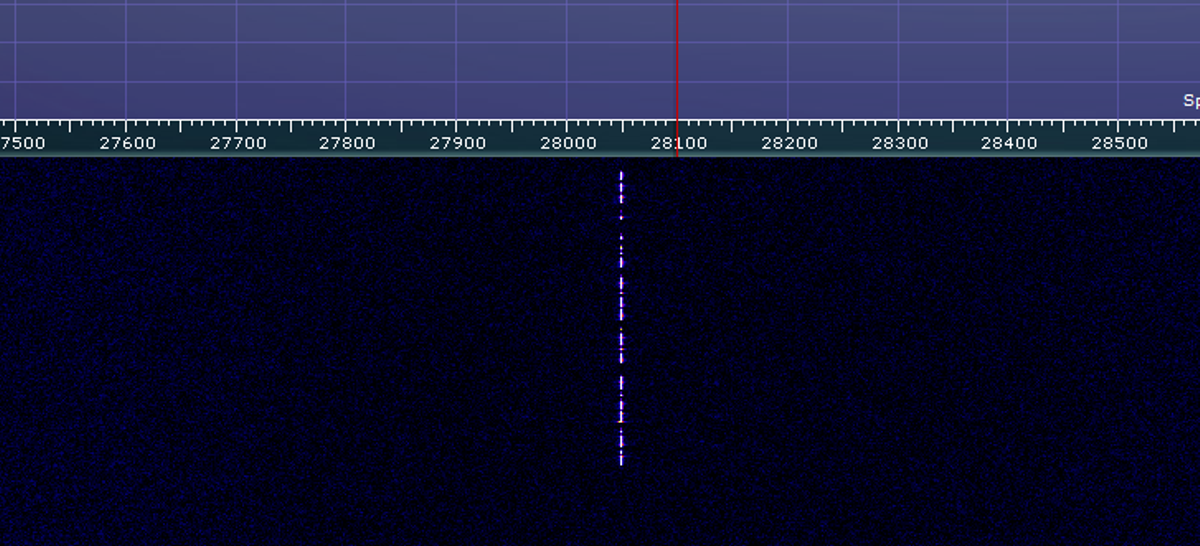
ASK is also an excellent playground for SDR experimentation. Generating an ASK signal in software is trivial, and watching the carrier switch on and off in a waterfall display is highly instructive. It makes it easy to understand at a glance how a digital modulation behaves, what its limitations are, and why more advanced schemes like FSK or PSK are far more robust. It is often used as a first exercise to introduce newcomers to the world of DSP (digital signal processing).
Observing an ASK signal on a waterfall display is almost poetic in its simplicity: a sequence of bright blocks appearing and disappearing, like a digital form of Morse code. The burst structure, symbol rate, and presence of preambles or synchronization patterns become immediately visible. It is one of the most intuitive ways to learn how to “read” digital signals visually.
Naturally, ASK’s simplicity is also its greatest limitation. Any amplitude variation—noise, fading, interference—can corrupt decoding. For this reason, in modern systems ASK has been almost entirely replaced by frequency- or phase-based modulations, which are far more resilient to channel imperfections. However, it remains a fundamental building block for understanding the evolution of digital modulation and for appreciating the difference between “modulating a signal” and “making it robust.”
In summary
ASK is a simple, direct, and educational modulation. It is not the most efficient or the most reliable, but it is an excellent starting point for understanding how digital communication arises and how a bit can be turned into a radio wave. And, for a radio amateur, it is also a way to rediscover that many modern techniques are rooted in concepts that have been known for a very long time.