PACTOR and VARA
PACTOR was developed in the late 1980s as an evolution of digital radio communication systems, with the goal of combining the robustness of RTTY with the speed of PACKET. The name itself comes from the fusion of PAcket and TOR (Teleprinting Over Radio), highlighting its hybrid nature. It was developed by Peter Martini and Hans-Peter Helfert, two German radio amateurs, and it quickly spread in amateur radio thanks to its ability to adapt to the varying conditions of the HF bands.
PACTOR uses a modulation based on FSK and PSK, with much more advanced coding and error correction techniques compared to earlier modes. Its key characteristic is adaptive transmission: the system automatically adjusts speed and encoding method according to radio channel quality. When the signal is strong and stable, PACTOR increases transmission speed; when the signal is weak or affected by fading, it reduces speed and strengthens error protection.
Over time, several versions have been developed. The first, PACTOR I (1989), is the original version, based on 200-baud FSK with automatic repeat request (ARQ) error correction. It allowed speeds of up to about 200 bit/s. In 1993, PACTOR II was introduced, using PSK modulation and more efficient coding, with speeds up to 800 bit/s and improved noise resistance. In 2002, PACTOR III arrived, using multi-carrier modulation techniques and dynamic compression, reaching speeds of up to 3600 bit/s under optimal conditions. The latest revision is PACTOR IV (2013), with speeds up to 10500 bit/s and continuous adaptation to propagation conditions.
Architecture
PACTOR is an ARQ (Automatic Repeat reQuest) system: every transmitted data block is acknowledged by the receiver. If the acknowledgment is not received or the block is corrupted, the transmitter resends it. This mechanism ensures high reliability even in the presence of noise and fading. It also integrates data compression and FEC (Forward Error Correction) algorithms, which reduce the amount of transmitted data and improve resilience.
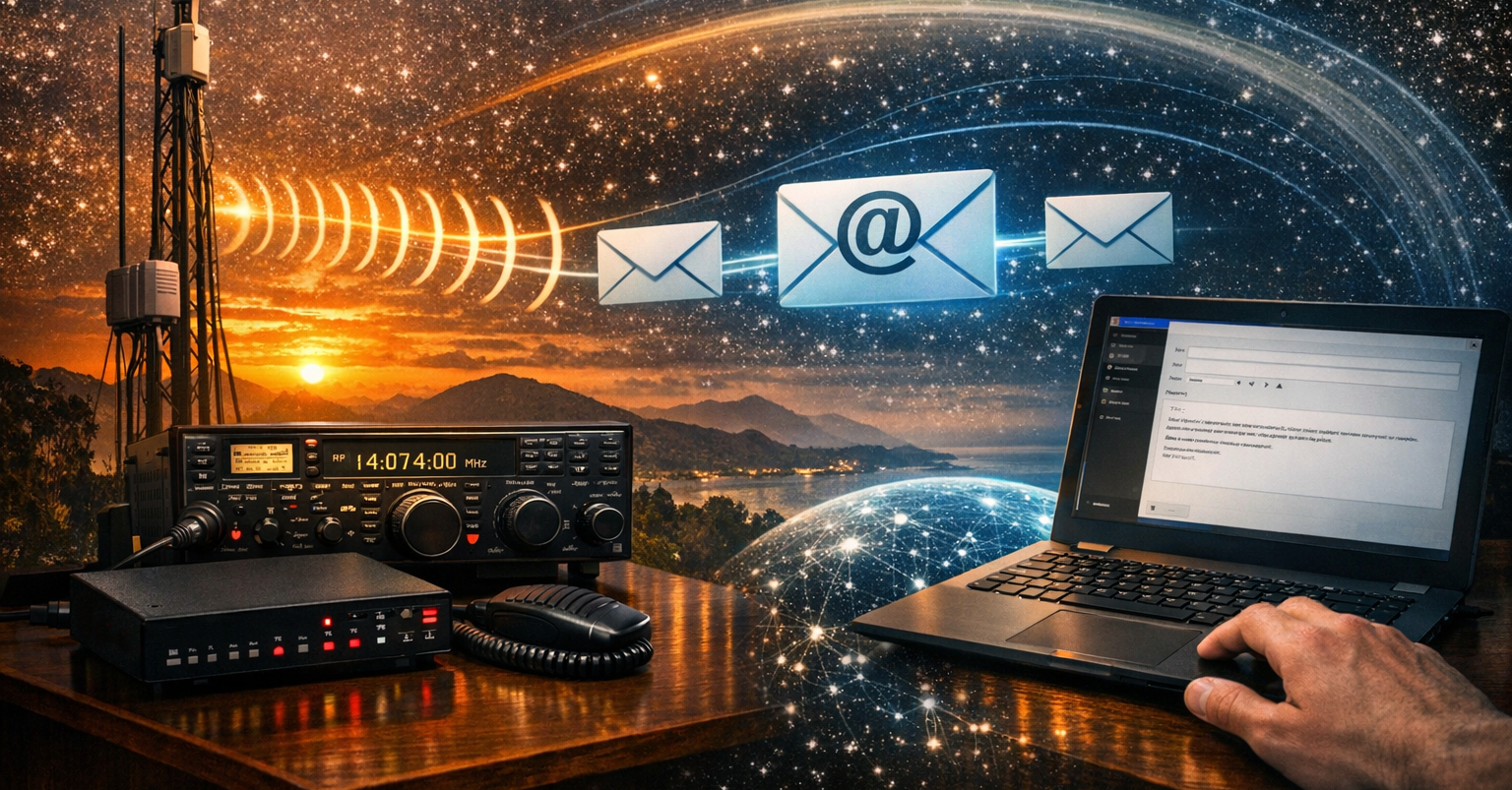
PACTOR has been widely used for sending email over radio and in emergency communications, establishing itself as a de facto standard for reliable data transmission in critical scenarios. Its architecture allows it to handle the inherent instability of HF bands, ensuring that messages are delivered without errors even under adverse propagation conditions. Thanks to this resilience, PACTOR has historically been the most widely used protocol in the Winlink network, enabling government agencies, rescue organizations, and radio amateurs to maintain a global email communication channel independent of public infrastructure. In disaster scenarios, where operational continuity is vital, PACTOR’s ability to send and receive attachments and text messages provides a crucial information flow for coordinating rescue efforts, even when the entire local internet infrastructure is unavailable.
However, PACTOR requires dedicated modems, and while this is not an issue in professional environments, the cost of the hardware is a significant entry barrier for radio amateurs.
VARA
Building on the experience of PACTOR, VARA was created by Spanish colleague José Alberto Nieto Ros (EA5HVK) with the goal of developing a software modem that could leverage the increasing computing power of standard PCs to implement advanced modulation techniques with comparable performance. VARA’s success comes from its development philosophy: instead of requiring a dedicated controller, it delegates all signal processing to the computer’s CPU, enabling dynamic performance, high transmission speeds, and robustness that has allowed VARA to become widely adopted on the Winlink network.
Compared to PACTOR-4, VARA adopts a different approach based on software flexibility and the use of OFDM modulation within an approximately 2400 Hz SSB channel. Both protocols use ARQ mechanisms and error correction techniques (FEC), but their implementation differs significantly.
PACTOR-4 does not use a classical OFDM structure: instead, it employs 10 adaptive speed levels based on modulation schemes up to high-efficiency PSK/QAM variants, with proprietary details, also remaining within an approximately 2400 Hz bandwidth. It also includes an adaptive equalizer capable of compensating for multipath, which contributes to its high robustness on degraded HF channels.
VARA’s OFDM architecture provides good resilience to multipath but requires a more linear audio chain and a relatively powerful PC, since all processing is done in software. PACTOR-4, on the other hand, delegates all processing to a dedicated hardware modem, ensuring consistent performance even with low-power computers.
In summary
PACTOR and VARA represent two distinct but converging approaches to reliable HF data transmission. The former, based on dedicated hardware and highly optimized proprietary protocols, prioritizes maximum robustness and operational predictability even under extremely degraded channel conditions. The latter, fully software-based, leverages modern DSP flexibility to offer high performance and accessibility, at the cost of greater dependence on audio chain quality and available computing resources.
Both systems introduce and consolidate fundamental concepts such as link adaptability, dynamic throughput management, and integration between physical layer and transport protocol, which are essential for dealing with the instability typical of HF channels. Although they remain niche solutions compared to more widespread modes, they continue to serve as technical references for applications where reliability, spectral efficiency, and link continuity are primary requirements.