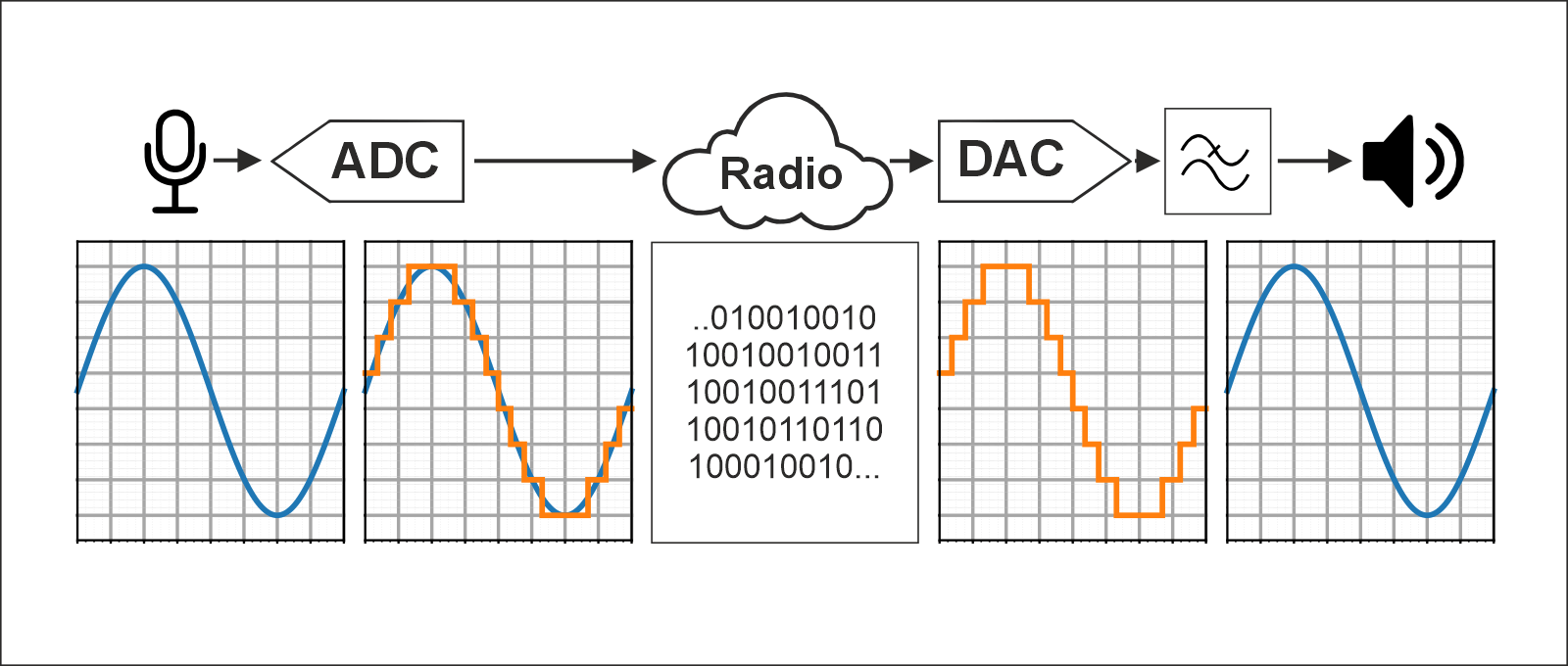
One of the questions I am asked most frequently when talking about digital voice is surprisingly simple: But what really changes compared to FM?
The short answer is: almost everything.
We are so accustomed to using DMR, D-Star or C4FM equipment that we tend to consider them a sort of evolution of analog FM, perhaps with better audio quality and some additional features. In reality, from a technical point of view, a digital voice communication has very little in common with a traditional FM communication.
When we use an analog radio, our voice is converted into an electrical signal that directly modulates a radio carrier. What reaches the receiver of our correspondent is, for better or worse, an analog representation of our voice. If the signal deteriorates, the audio we hear progressively deteriorates as well, introducing noise, hiss and distortion that every radio amateur knows very well.
Digital voice, on the other hand, follows a completely different path. When we press the PTT button, we are no longer transmitting our voice exactly as it comes out of the microphone, but rather a numerical representation obtained through a complex chain of digital processing.
Everything begins when the microphone converts air pressure variations into an analog electrical signal. This signal is immediately sampled by an analog-to-digital converter and transformed into a sequence of numbers representing our voice. At this point the signal is already digital, but it still has a problem: it is too “large” to be transmitted through a radio channel with limited bandwidth. A more detailed explanation can be found here.
It therefore becomes necessary to compress it.
This is where the voice codec comes into play, probably the most important component of the entire communication chain. Contrary to what one might think, a voice codec does not simply compress an audio stream in the same way as a common algorithm used for a music file. Its task is much more sophisticated: it analyses the characteristics of human speech and creates a mathematical model accurate enough to be represented using only a few thousand bits per second.
In a certain sense, the codec does not actually transmit our voice. Instead, it transmits the information required for the receiver to reconstruct an extremely similar version of it. The voice heard by our correspondent is therefore not our original voice, but the result of a reconstruction process performed by the receiving device.
If you are interested in how voice codecs work, I have already covered this topic in a dedicated page about the process of converting voice into digital format. Here, instead, we are interested in understanding what happens after the codec has completed its task.
A digital voice communication, in fact, does not carry audio alone. The data stream that will subsequently be transmitted through the radio channel contains many other types of information essential for the correct operation of the system. In addition to voice data, it also carries synchronization information, control data and all the elements required by the different protocols to manage users, talk groups and network services.
It is probably at this point that the difference compared to analog radio becomes most evident. When we use digital voice, we are not simply transmitting audio, but rather a structured data stream containing everything the system needs in order to operate correctly.
Before these data are transmitted, further processing steps are applied to make the communication more robust against the inevitable interference present on the radio channel. Part of the data is encoded with redundancy, allowing the receiver to detect and, in many cases, automatically correct errors introduced during transmission.
This mechanism explains one of the most characteristic behaviours of digital voice. Unlike FM, audio quality does not progressively degrade as the received signal becomes weaker. As long as the system can correct the errors present in the data stream, the audio remains virtually perfect. When the number of errors exceeds the correction capabilities provided by the protocol, communication degrades very quickly until it becomes unintelligible or stops completely. This is the phenomenon radio amateurs know as the digital cliff, one of the most evident characteristics of all modern digital voice systems. It is also one of the reasons why, in marginal coverage areas, FM communications often perform better than digital ones.
Once the data stream has been prepared, there is still another problem to solve: transmitting it over the air.
Here too, it is worth dispelling a common misconception. When we talk about digital communications, we tend to imagine that “zeros” and “ones” are transmitted directly through the air. In reality, things are somewhat more complex. Radio frequency remains an analog phenomenon and still requires appropriate techniques for modulating the carrier.
In other words, even a digital voice system uses analog modulation of the radio signal. What changes is the way information is represented and encoded within the RF carrier. It is precisely this set of techniques that distinguishes the different protocols currently used in amateur radio, and which I have discussed in detail here.
Once radiated by the antenna, the signal can follow paths that are very different from those typical of analog radio. This is where another element comes into play, one that has profoundly changed the way amateur radio communications are conceived.
Modern digital repeaters are no longer simple devices that receive a signal and retransmit it on another frequency. In most cases, they behave as true network nodes capable of routing communications through distributed infrastructures that extend far beyond the individual radio repeater.
A digital voice communication can follow a surprisingly complex path. The signal transmitted by our handheld radio might be received by the local repeater, routed to a national server, transferred through an international backbone and finally sent to a repeater located on the other side of the world before reaching our correspondent’s radio. From the user’s point of view, nothing changes at all: we simply pressed the PTT button. From a technical perspective, however, we are using a sophisticated infrastructure that integrates radio frequency, digital signal processing and IP networks.
The receiver will then perform the entire process in reverse. After demodulating the radio signal, it will correct any errors present in the data stream, extract the voice information, pass it through the codec and reconstruct the audio signal that will finally be reproduced through the radio speaker.
At this point it should be clear that digital voice communication has very little in common with the simple modulation of a radio carrier. In many respects, it is more accurate to consider it a distributed system for data processing and transport that uses radio frequency as one of the many available means of transferring information. When using a hotspot, as we will see later, the “radio” portion of the path may consist of only a few tens of centimetres.
And perhaps this is precisely the most important cultural change introduced by digital voice in amateur radio. We have stopped directly modulating our voice onto a radio carrier and have started transmitting information that allows another device to reconstruct it.
It may seem like a subtle difference, but it is exactly this transformation that has made possible the extraordinary features offered by modern digital voice systems. It is also the reason why, in the following articles, we will discover that behind apparently simple acronyms such as DMR, D-Star and C4FM there are technological choices, design compromises and even different philosophies about what digital amateur radio should represent.