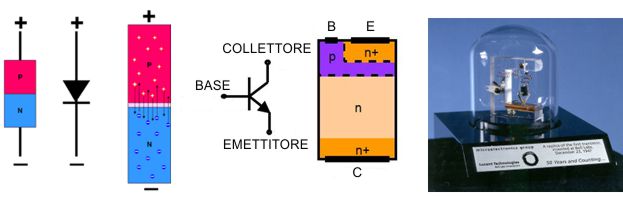
Diodes, transistors and semiconductors
With this page we enter the world of semiconductors, the components that make it possible not only to allow current to flow or to store it (as resistors, capacitors and inductors do), but also to control and amplify it. They are, quite literally, the building blocks of modern electronics.
The diode, our first semiconductor
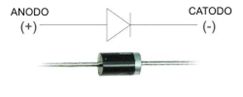
The diode is not an active component (it does not amplify anything), but it is the first semiconductor we encounter in this course. Its behaviour is as simple as it is fundamental: it allows current to flow in only one direction.
- if the anode is biased positively, current flows through the diode;
- if the anode is biased negatively, it behaves as an open circuit.
In practice, a diode starts conducting significantly only above a certain threshold voltage, typically around 0.6–0.7 Volts for silicon diodes and around 0.2–0.3 Volts for germanium diodes.
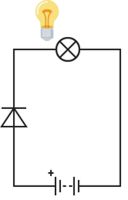
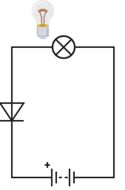
Every diode is characterized by a maximum voltage and current rating that it can withstand, beyond which it may be damaged. There are entire families of diodes with specific additional characteristics (Zener diodes, LED diodes, varicap diodes, and so on; we will return to the latter when discussing the Pixie).
A practical but essential detail: semiconductors are always identified by markings printed on their body, and in diodes the cathode (K) is identified by a coloured band printed at one end of the component. Installing a diode with the wrong orientation is one of the most common mistakes made by beginners — and even in the Pixie, as we will see, it has very concrete consequences.
What are semiconductors?
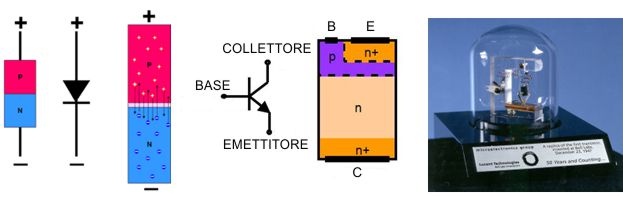
Semiconductors are made from the junction of elements that have been intentionally made impure (doped). The impurity determines the polarity of the material region: n-type junctions have an excess of electrons, while p-type junctions have a deficiency of electrons.
- Diodes have a single pn junction.
- Bipolar transistors have two junctions (pnp or npn structure), and are active components: unlike a diode, they do not simply allow or block current, but control it.
In a transistor, the bias applied to the central terminal — the base — determines the current flowing through the other two terminals (collector and emitter). Continuing with the hydraulic analogy introduced earlier, a transistor works like a kind of valve: a small variation at the base produces a much larger variation in the main current flow. It is precisely this property that allows an extremely weak signal, for example coming from an antenna, to be amplified and made usable.
A brief historical note: vacuum tubes
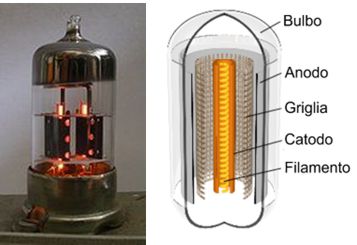
Before the advent of transistors, the same function of controlling the flow of electrons was performed by vacuum tubes (also called valves). The operating principle is, conceptually, the same: moving electrons in a single direction and regulating their flow.
- the electron flow is generated by heating a metal plate, the cathode;
- the regulator consists of one or more grids, whose potential controls the passage of electrons (conceptually very similar to what happens with the base of a transistor);
- a further plate, the anode, collects the outgoing electrons.
Vacuum tubes have now been largely replaced by semiconductors in almost all applications, but they remain an important part of history — and they still survive in some niches, such as high-fidelity audio amplifiers or some high-power RF final stages.
The transistor
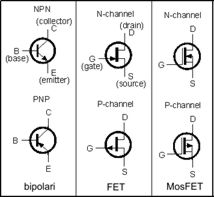
The transistor is an active semiconductor, and the term actually includes many different families of components, often with very different characteristics (bipolar transistors, FETs, MOSFETs…). It can be used to amplify a signal or to switch a current (turning it on and off, like an electronic switch). There are thousands of transistor models, with different electrical and mechanical characteristics, and every component has specific technical documentation — the so-called datasheet — which lists all its specifications.
The pinout
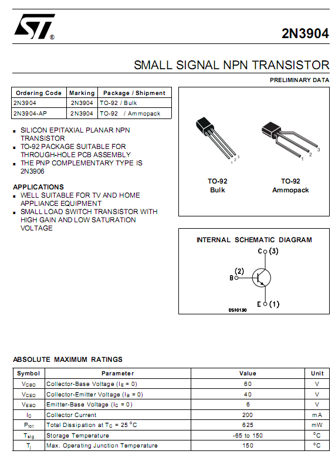
Many of the characteristics reported in a datasheet are mainly useful during the design phase. However, there is one that is fundamental even during simple assembly: the pinout, meaning the arrangement of the terminals (base, collector, emitter). Even when assembling a pre-designed kit such as the Pixie, it is essential to always verify the correct pin arrangement before soldering: a transistor installed backwards, in the best case, will simply not work; in the worst case, it may be permanently damaged.
Soon we will take a closer look at the transistors used in the Pixie and realize that, in the end, a large part of the transceiver is built around them. Learning to recognize them and understand how they work therefore means taking another small step towards building our own radio.