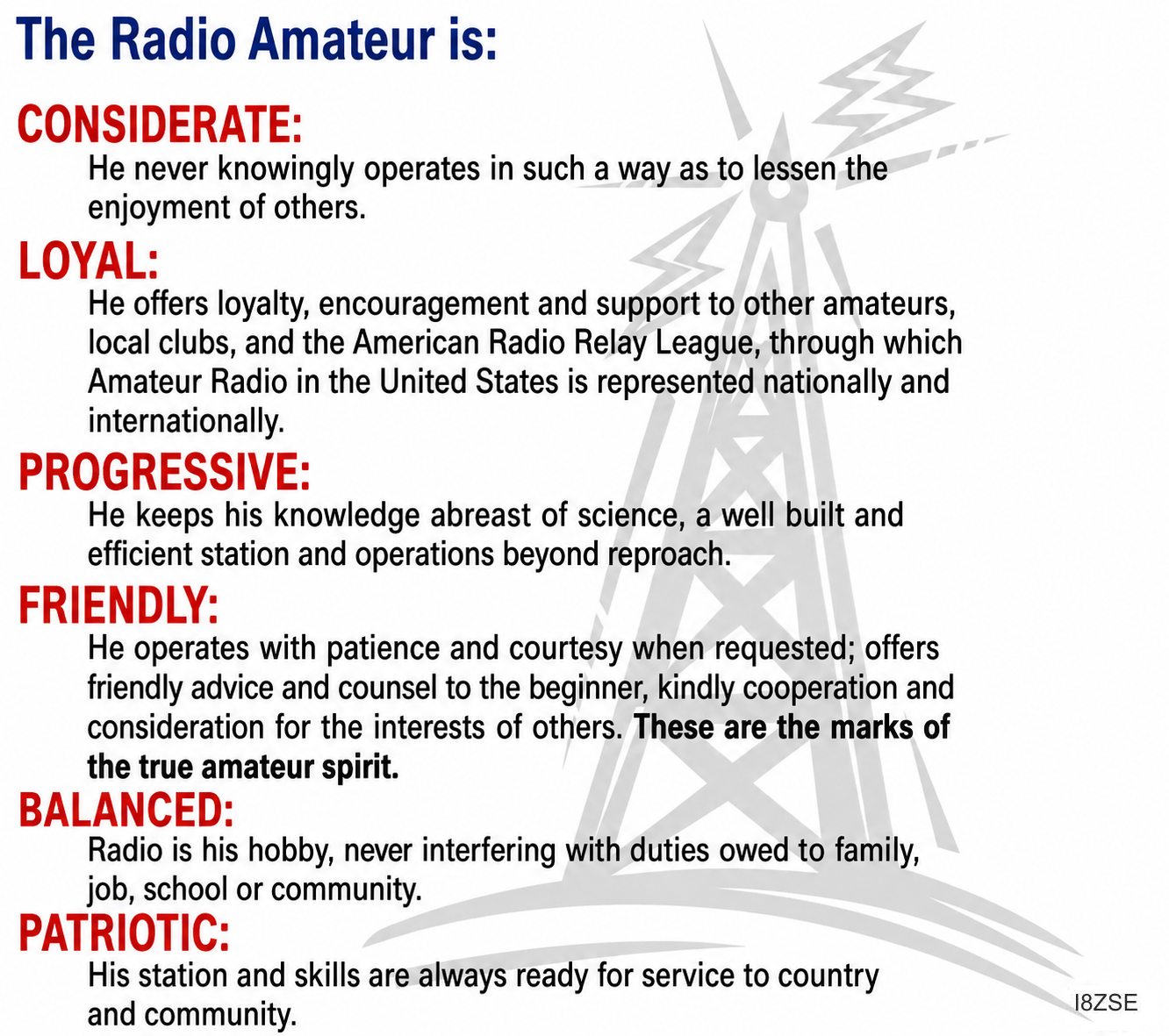
The Amateur’s Code, Nearly One Hundred Years Later
The Amateur’s Code – the manifesto written by W9EEA Paul M. Segal in 1928 – still raises an interesting question almost one hundred years after it was written: does it still make sense in a world that has changed so profoundly?
I believe the underlying message of W9EEA’s manifesto remains remarkably relevant, even though the world in which it is applied is light-years away from that of a century ago.
The Amateur’s Code described the radio amateur as considerate, loyal, progressive, friendly, balanced, and patriotic. It was an era when radio was a frontier technology: amateurs built much of their own equipment, constantly experimented, and represented a valuable technical resource for society.
Today, the landscape is very different.
First of all, radio is no longer an exclusive technology. Everyone communicates every day through radio systems without even realizing it: smartphones, Wi-Fi, Bluetooth, cellular networks, satellites. The radio amateur is no longer the only person mastering wireless communications.
The technical profile has changed as well. During the 1920s and 1930s, homebrewing equipment was almost a necessity; today, one can be an excellent operator using highly sophisticated commercial equipment. At the same time, entirely new fields of experimentation have emerged – ones that Segal could never have imagined: SDR, DSP, FPGA, IP networking, satellites, digital communications, open-source protocols such as M17 and Codec2, telemetry, and integration with Linux and microcontrollers. Experimentation has not disappeared; it has simply moved in new directions.
The social role of the radio amateur has evolved too. In 1928, amateur radio was widely regarded as a laboratory for technical innovation and a pool of telecommunications expertise. Today, that added value is more difficult to communicate to the outside world. In many cases, amateur radio is seen simply as a hobby, although it continues to play an important role in experimentation, technical education, and, in certain circumstances, emergency communications.
There is another aspect that the manifesto, of course, could never have anticipated: the Internet. Today’s amateur radio community exists as much online as it does on the air. This has brought enormous advantages, but also many of the dynamics typical of social media: polarization, sterile arguments, and technological “tribalism” (DMR versus D-STAR, analog versus digital, HF versus VHF…). These are phenomena that sit uneasily with the spirit of courtesy and openness described by Segal.
If I were to rewrite the manifesto today, I would probably leave its ethical principles almost untouched, but I would redefine what it means to be progressive. In 1928, it meant embracing new radio techniques; today, it should primarily mean understanding technology, sharing knowledge, contributing to open projects, documenting one’s work, and maintaining a scientific mindset, avoiding both the rejection of innovation and uncritical enthusiasm for every new technology.
There is another adjective in the Code that deserves the same kind of reinterpretation: patriotic. In 1928, it was a natural choice, at a time when amateur radio was closely tied to national interests. Today, in a hobby defined by international communities, DXing, and cooperation across borders, the word can sound somewhat out of place if taken literally. Yet if we look at the principle behind it-placing one’s skills at the service of others whenever needed-its meaning remains entirely relevant. It has simply shifted from the national sphere to that of emergency response and public service. Consider the amateur radio networks activated during natural disasters, the support provided by amateur radio organizations working alongside civil protection agencies, or simply the individual operator who keeps a station ready for local emergencies: this is exactly the same spirit described by Segal, only with a label better suited to our times. No longer patriotic, but rather committed.
In other words, I believe the manifesto has not aged because it was never really about equipment or operating practices-it was about attitude. The world of radio has changed, but the idea that a radio amateur should be knowledgeable, curious, helpful, and respectful remains just as valid today as it was nearly a century ago. If anything, it is more difficult to live up to those ideals today, because technology offers far more opportunities, but also far more distractions that can cause us to lose sight of the spirit in which it should be used.
Share this content:
Post Comment