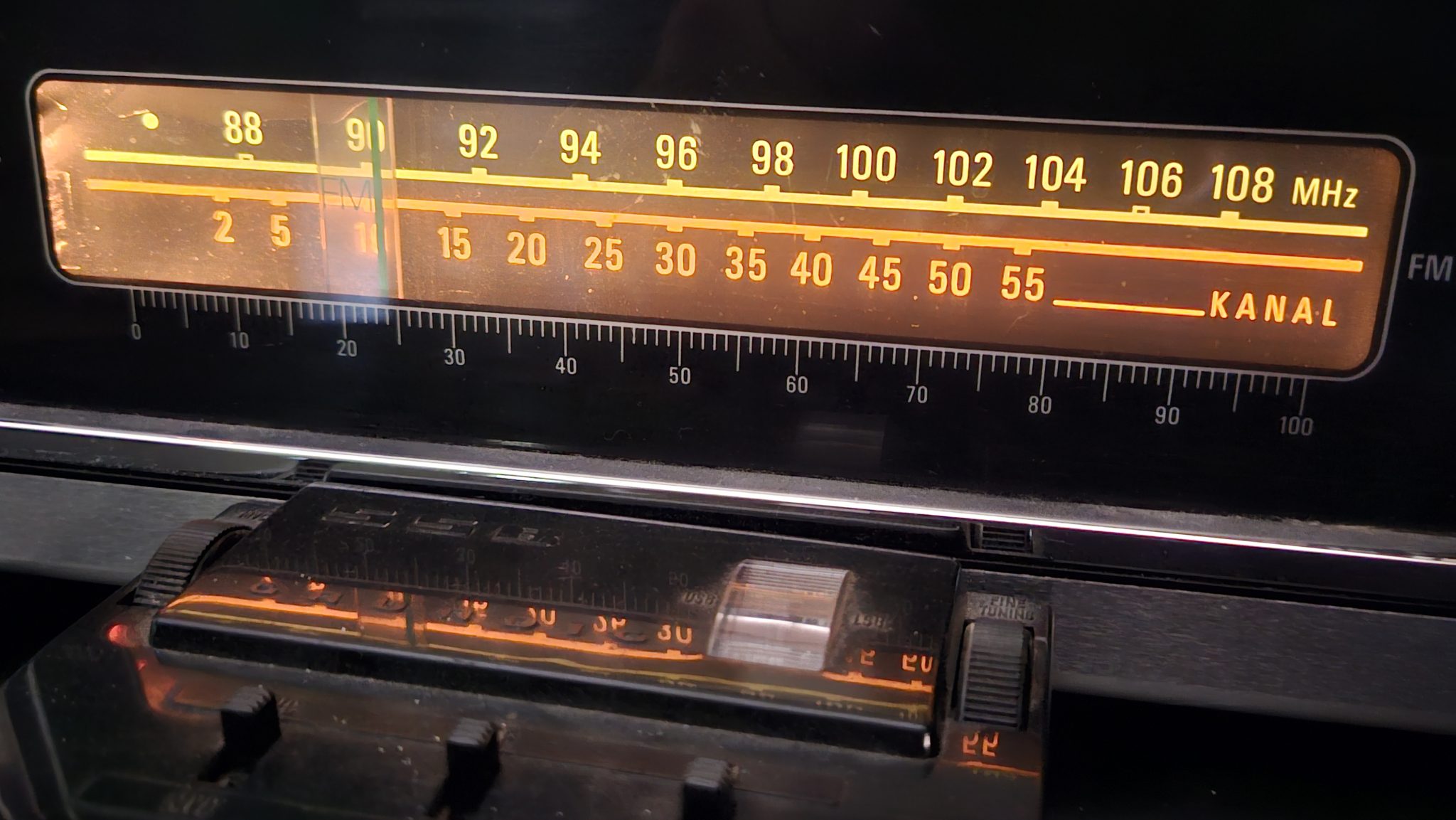
Alongside amplitude modulation, a fundamental role in the history of radio communications is played by frequency modulation (FM), in which information is not impressed onto the amplitude of the carrier, but onto its instantaneous frequency. In this case, the carrier maintains a substantially constant amplitude while its frequency varies over time following the behavior of the modulating signal. This approach represents an important conceptual shift from AM, since it separates the information content from amplitude variations, which are typically associated with noise.
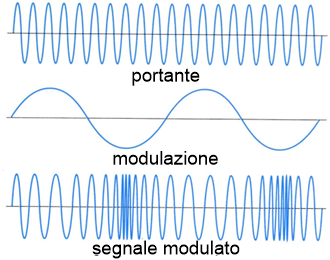
The idea of using frequency as the information-bearing parameter was developed and promoted during the 1930s by Edwin Howard Armstrong, who demonstrated its advantages in terms of signal quality and robustness. Since noise in radio channels primarily manifests itself as random amplitude variations, FM is inherently less sensitive to interference than AM. In the receiver, a limiting stage removes most unwanted amplitude variations before demodulation, significantly improving the signal-to-noise ratio.
From an operational perspective, in frequency modulation the modulating signal causes the carrier frequency to deviate around its central value. The maximum extent of this variation is known as the frequency deviation and is one of the fundamental parameters of the system. Closely related to it is the modulation index, which represents the ratio between the frequency deviation and the highest frequency component of the modulating signal. This parameter directly determines the spectral characteristics of the transmitted signal.
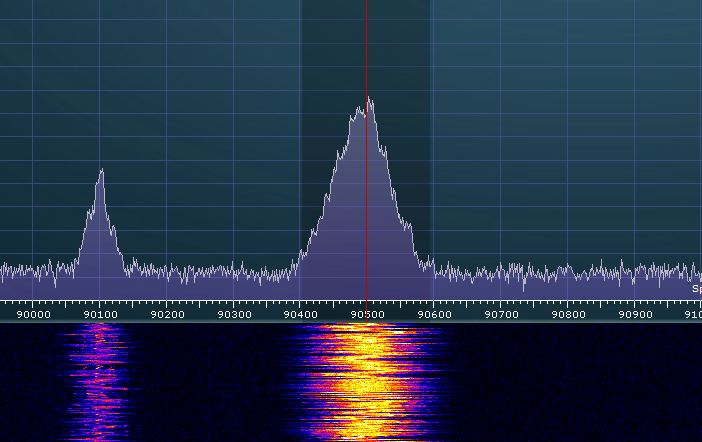
Unlike amplitude modulation, the spectrum of an FM signal is not limited to a few discrete components but theoretically extends to an infinite number of sidebands distributed symmetrically around the carrier. In practice, however, most of the energy is concentrated within a finite bandwidth, which can be estimated with good accuracy using Carson’s Rule: the occupied bandwidth is approximately equal to twice the sum of the frequency deviation and the maximum frequency of the modulating signal. This means that FM, especially in its wideband form, requires significantly more spectrum than AM.
In the receiver, demodulation is performed by circuits capable of converting frequency variations into amplitude variations, which are then transformed into an audio signal. Among the most widely used methods are the frequency discriminator and the ratio detector, alongside more modern solutions based on Phase-Locked Loop (PLL) techniques. The presence of the limiter and the very nature of the modulation make FM particularly well suited to the transmission of high-quality audio signals.
Frequency modulation lends itself to different operating modes, which are distinguished primarily by the magnitude of the frequency deviation. Commercial broadcasting uses Wideband FM (WBFM), characterized by large deviations and bandwidths on the order of hundreds of kilohertz, enabling high-fidelity audio reproduction. In amateur radio and mobile communication services, Narrowband FM (NBFM) is used instead, with deviations typically of only a few kilohertz, allowing more efficient spectrum utilization while maintaining good noise immunity.
In amateur radio, FM is widely used for VHF and UHF communications, particularly through repeater systems that greatly extend the range of individual stations. Its ease of use, excellent intelligibility, and robustness against interference make it ideal for local and operational communications. However, the phenomenon known as the capture effect causes a receiver, when presented with two signals on the same frequency, to demodulate almost exclusively the stronger one while suppressing the weaker. While this behavior is advantageous in terms of clarity, it limits the ability to hear weak signals in the presence of interference. This is one of the reasons why certain services—such as aeronautical voice communications—continue to prefer amplitude modulation.
In summary, frequency modulation represents a more complex and bandwidth-intensive solution than AM, but it offers significantly superior performance in terms of audio quality and noise resistance. For this reason, it has become the preferred choice in many application areas, from broadcast radio to professional and amateur radio communication systems