The digital laboratory for radio amateurs
Fldigi, an acronym for Fast Light Digital, is a free and open-source software developed and maintained by the team led by Dave Freese, W1HKJ, with contributions from other developers in the international amateur radio community. Originally created as an audio modem application for HF digital modes, it has evolved over the years into one of the main reference tools for operating digital modes without relying on proprietary or commercial solutions.
The operating principle is simple in its architecture: Fldigi uses the computer’s sound card as the interface between the software and the transceiver. The audio signal coming from the radio is sampled, analyzed, and processed in real time, and in the same way the software generates audio tones which—when sent to the radio’s microphone input or data port—become the transmitted signal. This fully audio-based approach means that everything happening in the transmission chain is visible and measurable: excessive audio levels immediately cause detectable distortion, an overly narrow IF filter appears in decoder behavior, and a dirty modulation is visible on the waterfall before text is even lost.
The graphical interface includes three signal analysis tools: the waterfall, which displays frequency and intensity over time in a two-dimensional view; the spectrum scope, which provides an instantaneous view of spectral density; and an oscilloscope, useful for evaluating the audio waveform. Together, these tools allow immediate diagnosis of received signal quality and verification of correct transmitter setup.
Fldigi supports a very wide range of digital modes, including PSK31 and its variants (PSK63, PSK125), MFSK in various configurations, Olivia, RTTY, Hellschreiber, DominoEX, Thor, WSPR, and CW. PSK31 is particularly sensitive to frequency alignment: even a few Hertz of offset between stations result in decoding errors, and the waterfall makes this immediately visible. Olivia, on the other hand, is designed to withstand difficult propagation conditions thanks to a multi-tone structure with built-in error correction. MFSK, also multi-tone, requires a well-calibrated audio chain and can therefore serve as an indirect indicator of station quality.
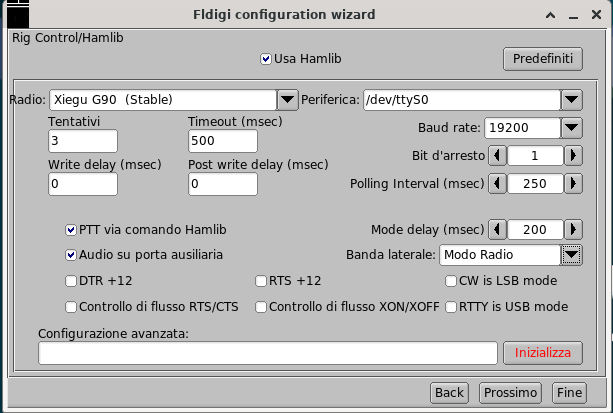
On the radio control side, Fldigi offers three distinct methods. The most common is integration with FlRig, an application from the same suite dedicated to CAT transceiver control, which manages radio communication independently and provides Fldigi with frequency and operating mode information. It also supports direct use of Hamlib, an open-source library that provides a unified software interface for hundreds of radio models from different manufacturers: this broad compatibility makes Fldigi usable with virtually any modern transceiver, regardless of brand.
It is important to define the scope of Fldigi to avoid incorrect expectations. The WSJT family weak-signal modes—FT8, FT4, JT65, JT9 and others—are not supported: these are protocols with second-level time synchronization, predefined message structures, and a completely different operating logic, requiring dedicated software such as WSJT-X. Likewise, Fldigi does not handle SSTV, which operates with digitized images, line synchronism, and its own frame timing. Anyone looking for a universal decoder will inevitably find Fldigi’s limits; however, those seeking a tool for traditional audio-based digital modes, with full visibility of signal behavior, will find one of the most complete environments available.
The associated application suite completes the ecosystem. FlRig manages transceiver control. FlMsg is dedicated to composing and handling structured messages according to formal operational standards, including ICS modules used in emergency communications. FlAmp implements a file transfer protocol with block segmentation and checksums, designed to ensure data recovery even under degraded channel conditions. FlWrap adds an integrity-check layer to text messages before transmission. These are tools designed not for casual use, but for operators working in structured traffic environments, civil protection exercises, or emergency communications.
Fldigi is preinstalled in HamLinux, but of course requires initial configuration to operate. Nothing complicated: it is enough to complete the fields in the initial configuration wizard. The only steps requiring attention are related to interface setup: simply follow the instructions in this post. Several configuration pages are dedicated to rig control. Fldigi can operate with flrig, rigcat, and hamlib: I prefer using the latter option. I have dedicated a post to hamlib.
Fldigi has an excellent online manual, (in Italian) while from the W1HKJ website it is also possible to download the PDF version.