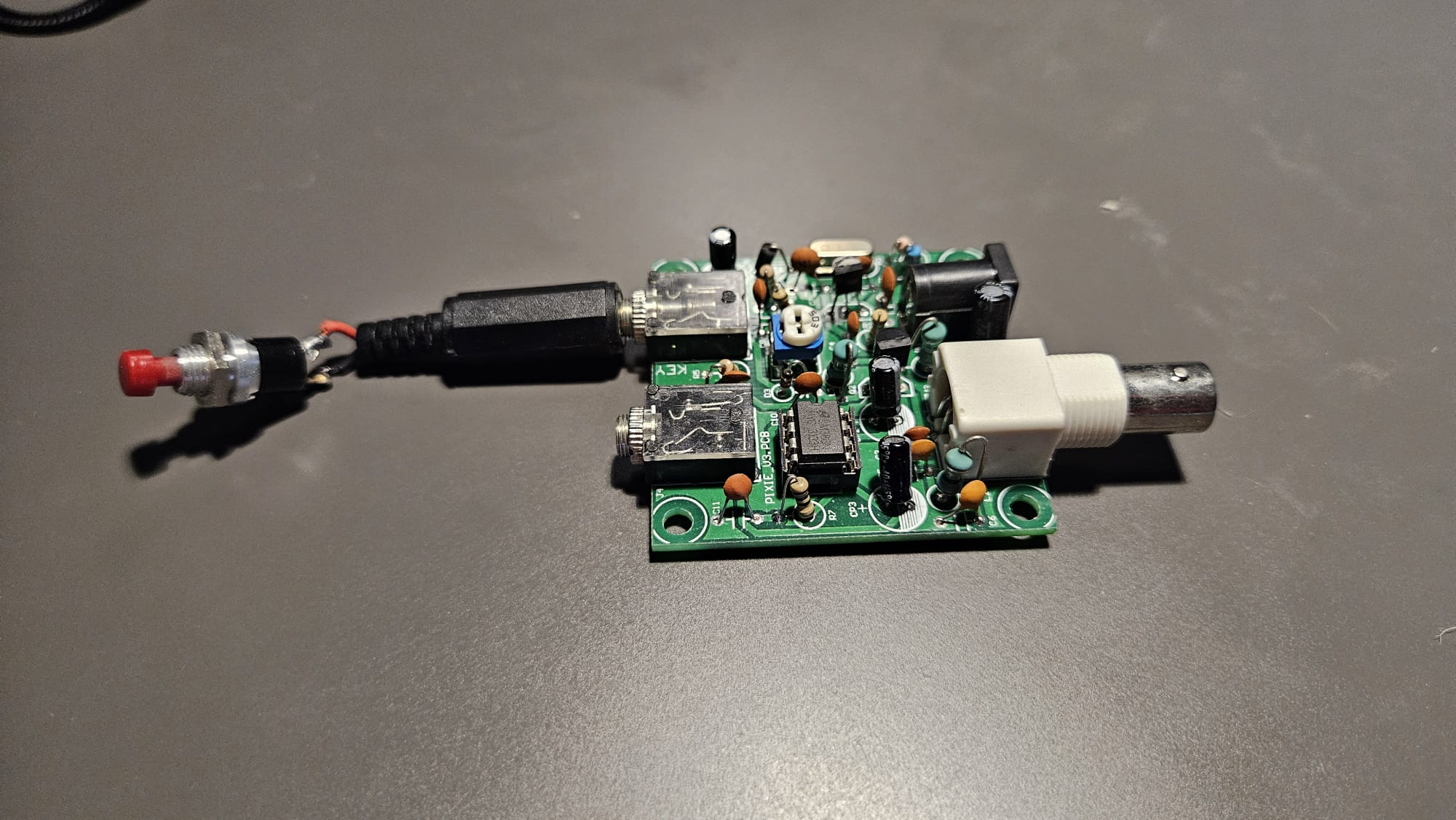
The Pixie
An introduction to the world of electronics through a kit
This section of my website collects a series of pages designed to guide you, step by step, through the construction of a small CW transceiver: the Pixie. It is available as an inexpensive kit, within everyone’s reach.
The goal of this journey is twofold: to demonstrate in a practical way that it is possible to build radio equipment using simple and accessible tools, but also to use the construction of this small device as the perfect opportunity to understand the fundamentals of electronics and truly understand how what we are building works. This series is based on a course I held at the ARI (Italian Amateur Radio Association) Potenza radio club in 2017.
It is intended for those approaching the world of radio and electronics for the first time, and therefore no previous knowledge of electronics is required: the idea behind this journey is precisely to acquire that knowledge step by step, component by component.
What is the Pixie?
The Pixie is an extremely simple CW (Morse code) transceiver, capable of operating with only two transistors. It was designed by Dave Joseph (WA6BOY, later W7AMX), who in 1995 published the Pixie 2 version in the QRPp magazine of the NorCal QRP Club, modifying an earlier design: the Micro-80, created by Russian radio amateur Oleg Borodin (RV3GM) and published in 1992 in the SPRAT magazine of the British G-QRP Club.
The basic idea of using the same transistor both as a receiver mixer and as a transmit power amplifier actually dates back to an even earlier design: the FOXX by George Burt (GM3OXX), described in SPRAT in 1983. The Pixie is therefore the latest (and most essential) step in an evolution that, over the years, progressively reduced the number of components while still maintaining a functional device capable of making real contacts.
Some practical features:
- it can operate on the 80 metre or 40 metre band, simply by adapting some components (in particular the crystal and the values of some inductors). It is worth noting that the Chinese kits available today are all designed for 40 metres;
- it does not require rare or difficult-to-find components;
- it is extremely inexpensive: complete kits can be found online starting at around €5;
- the typical output power, depending on the supply voltage and the actual transistors installed, ranges from 200 mW up to about one watt: very little compared with modern standards, but enough, with a good antenna, to achieve real CW contacts, especially under favourable propagation conditions.
Why build this particular kit?
The Pixie is not a high-performance receiver, nor is it a particularly clean transmitter from a spectral point of view (we will return to this topic later, when discussing harmonics and filters). Its educational value lies elsewhere: with just a few dozen components, it clearly summarizes all the functional blocks of a radio — power supply, oscillator, mixer, power amplifier, filter, audio amplifier — allowing you to follow, with a multimeter (or, even better, with an oscilloscope if available), the signal as it is generated, transformed and finally sent to the antenna.
In an age where we are accustomed to devices integrating thousands of invisible components inside a single chip, the Pixie allows us to see and understand almost every function of the radio we are using. The Pixie is not interesting because it is cheap: it is interesting because it is probably one of the very few radio devices that can be understood without being overwhelmed by the complexity of modern electronics.
Building it with your own hands, understanding what each component does, is probably the most effective way to take the first real step into the world of electronics applied to radio.