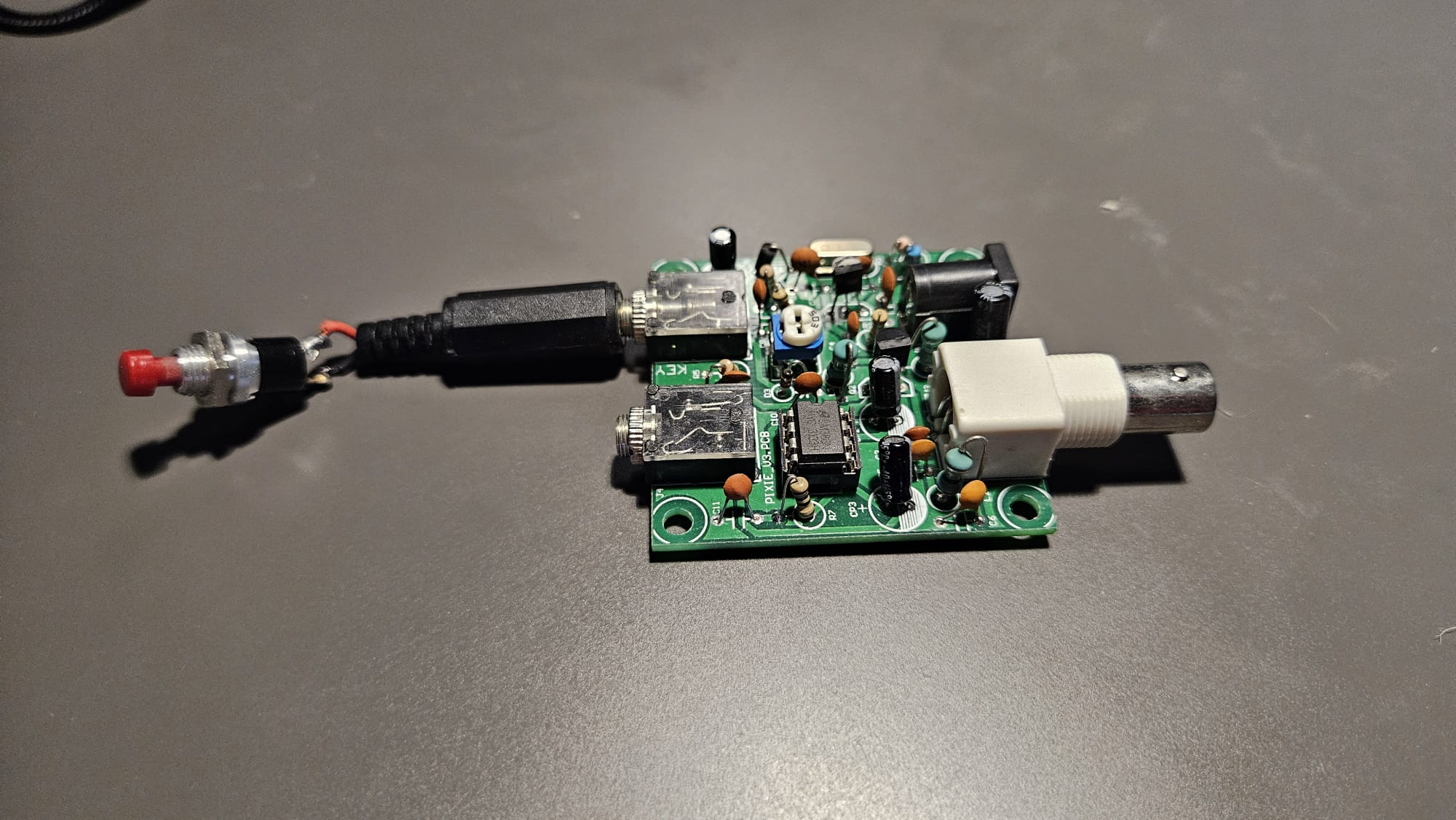
Building to Understand
For anyone approaching electronics and amateur radio today, one of the main challenges is that almost everything has become something of a black box: increasingly sophisticated equipment, integrated circuits that encapsulate entire functions, and very few opportunities to truly understand what is happening inside a transceiver.
For this reason, I decided to republish, completely revised and updated, the material from a course I taught in 2017 at the ARI (Italian Amateur Radio Association) Potenza radio club, dedicated to building the Pixie, one of the best-known direct-conversion QRP transceivers.
The goal of the course has never been simply to assemble a kit, and for this reason it is not just another tutorial. Instead, the Pixie serves as the common thread through a journey that begins with the fundamentals of electronics and gradually leads the reader to understand the main functional blocks of a radio: the power supply, crystal oscillator, mixer, RF power amplifier, output filter, and audio amplifier.
Each component is introduced at the point where it actually appears in the circuit, bridging theory and practice by explaining not only how a component is installed, but above all why it is there and what role it plays in the overall operation of the circuit.
The new section also includes a practical assembly guide, advice on proper soldering techniques, and a chapter dedicated to testing and commissioning the completed circuit, with particular attention to regulatory aspects and good operating practices.
The Pixie is an extremely simple design and certainly cannot compete with modern transceivers in terms of performance. Yet this very simplicity makes it an outstanding educational tool: with only a few dozen components and a very modest cost, it is possible to follow the path of a radio signal from the battery all the way to the antenna, learning principles that are still found—albeit in much more sophisticated forms—in today’s transceivers.
Whether you are taking your first steps in amateur radio, interested in homebrewing your own equipment, or simply want to rediscover the pleasure of understanding how a radio really works, I hope you will find this course both useful and enjoyable.
Enjoy the reading… and happy soldering!
The course is available in the site’s Pixie section.
Share this content:
Post Comment