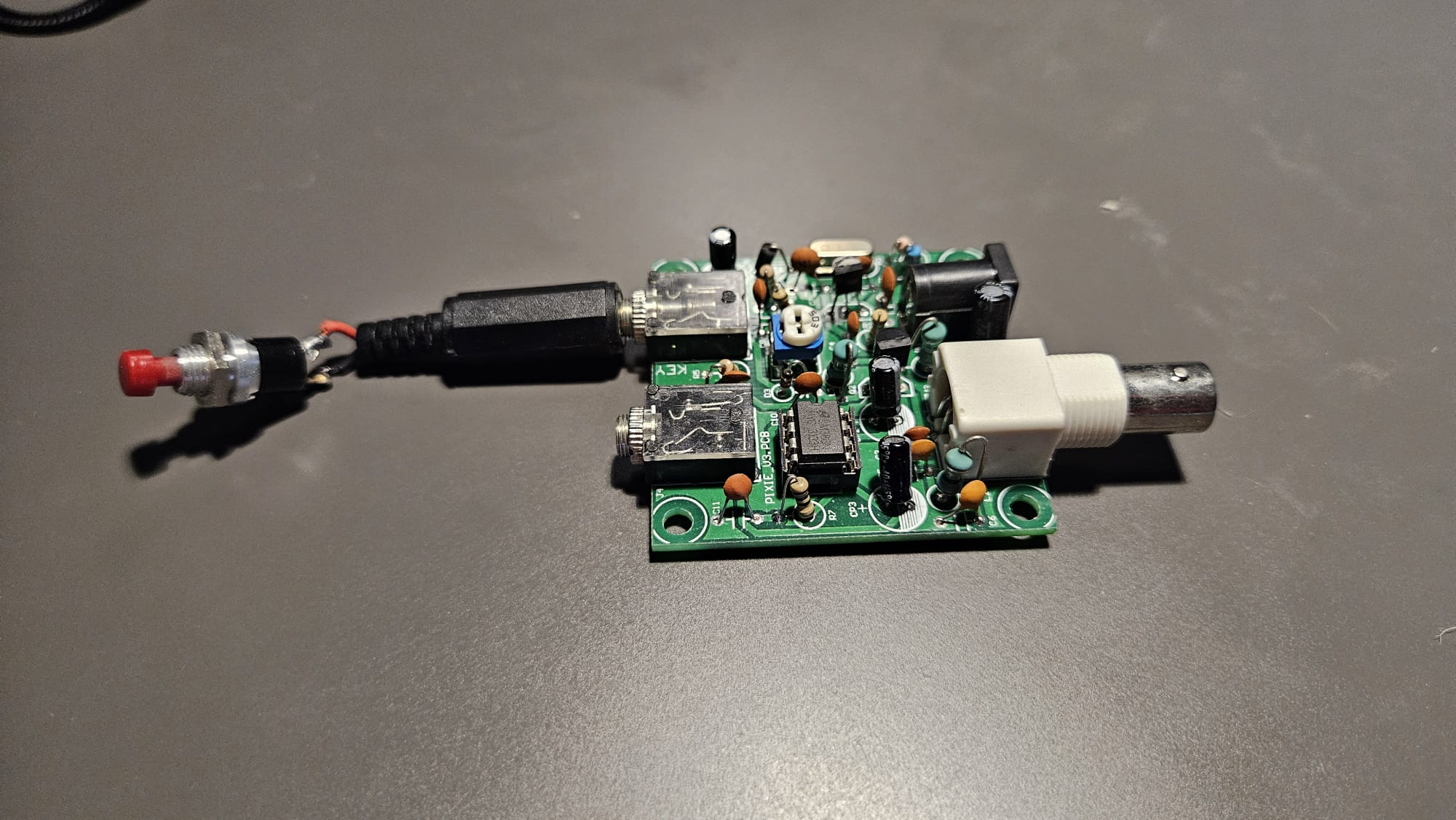
Once the assembly is complete, take the time necessary to carefully check all the solder joints. Remember that haste is a bad advisor. After this essential step, before thinking about making a real radio connection, there is one more step that must not be skipped: testing.
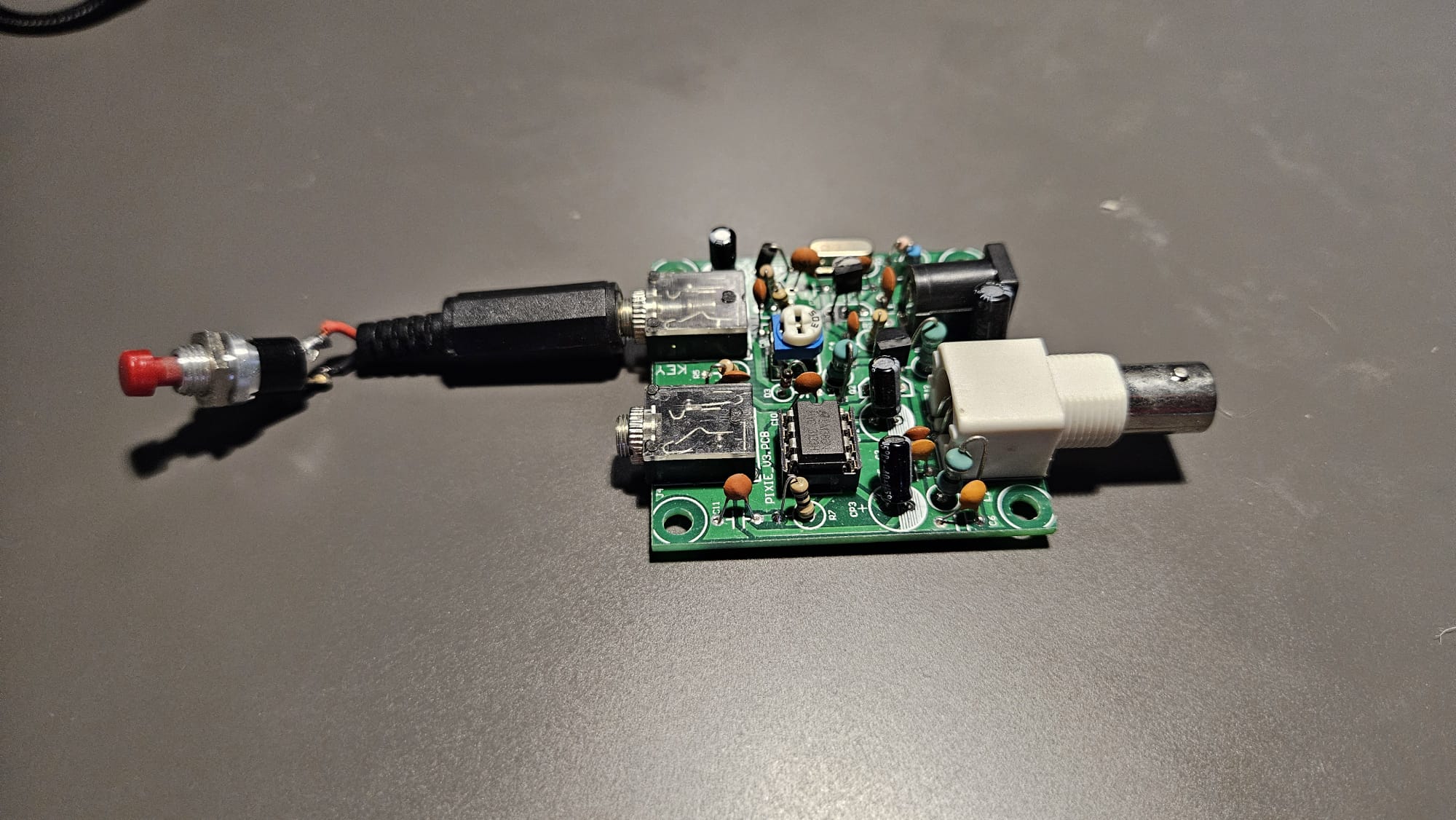
First rule: to go “on air” you need a license
It must be stated clearly, before anything else: connecting the Pixie to an antenna and actually transmitting on amateur radio bands requires holding an amateur radio license and the corresponding authorization/callsign. Transmitting without a license, even with extremely low power, is not only unfair to the amateur radio community, but is also subject to legal penalties. Everything described on this page, however, can be done legally even without a license, because it does not involve the emission of a significant signal towards the outside world.
How to test the circuit without transmitting “on air”
The beauty of a project like the Pixie is that it is perfectly suited for gradual testing, at low power and over very short distances, well before (and independently of) obtaining a license:
- check the continuity between positive supply and ground;
- check the power supply voltage;
- measure the current consumption with no signal applied;
- connect a 50 Ohm/1 W non-inductive dummy load to the BNC connector instead of the antenna (or even a short piece of wire, a few tens of centimetres long): the signal generated by the oscillator, and later by the PA, will be radiated so weakly that it will remain confined within the room, but still strong enough to be received a few metres away. The purpose is not to transmit, but to verify that the internal stages of the circuit are working correctly;
- use a second receiver (even a simple commercial receiver or an inexpensive SDR, tuned to the frequency of the installed crystal) to verify that the oscillator starts correctly and that the signal is stable;
- in reception, you can verify the operation of the Pixie itself by listening to stations present in the band with a suitable antenna, or by receiving the signal from a generator or another low-power transmitter nearby;
- by pressing the key, with the short wire antenna connected, you can verify – again using the second receiver placed nearby – that the PA actually switches into operation, by listening to the generated tone.
This type of “short-range” test allows you to verify that all stages are working – power supply, oscillator, mixer, PA and audio – without ever emitting a signal capable of actually propagating on the band, and therefore without requiring a license. The chain is missing the most important component – the antenna. This is the most sensible way for anyone still preparing for the exam to verify, with their own hands, that their soldering work has brought a working circuit to life.
Only after obtaining the license, with an antenna suitable for the chosen band (80 or 40 metres) and with the proper awareness of good operating practices on the air, will it make sense to attempt a real CW contact. And I can assure you that making a QSO in CW with such a simple device, built with your own hands, is a truly memorable experience.
A final word
If this circuit – so simple, so inexpensive, so accessible to anyone – exists and can be reproduced by anyone who wishes to build it, it is not thanks to the person writing these pages. It is thanks to a chain of people who, over more than forty years, chose to share their work rather than keep it to themselves: George Burt (GM3OXX), who published the FOXX in SPRAT in 1983; Oleg Borodin (RV3GM), who developed the Micro-80 almost ten years later as an evolution of the same concept; Dave Joseph, who simplified it even further into the Pixie you have in your hands.
It is a tradition that has always run throughout amateur radio, since its origins: publishing schematics, measurements, faults and corrections, without patents or secrets, so that those who come afterwards can start from there rather than from scratch. This course – which in itself does not invent anything technically new – aims to be one more small link in that same chain: if one day any of you feels like building the Pixie, modifying it, improving it, or simply explaining it to someone else, you will have done exactly what I had in mind when I wrote this course in 2017.
73 de I8ZSE