Beyond voice: technology, openness and the future of amateur radio
When we began this journey through digital voice, the question seemed apparently simple: how is an analog voice transformed into a digital communication on the VHF and UHF bands?
But by following the evolution of the different systems, we discovered that the technical answer is only one part of the story. Digital voice is not merely a new transmission method. It is the point where amateur radio meets some of the major technological transformations of the last decades: the spread of computing, IP networks, software and complex systems.
It is precisely this encounter that has generated the true “paradox” of digital voice.
On one side, we have extraordinarily efficient systems, capable of carrying voice communications across the world using small, inexpensive and technologically advanced equipment. On the other side, we have introduced into our hobby technologies in which a significant part of the internal operation is no longer directly accessible to the user.
An inevitable revolution
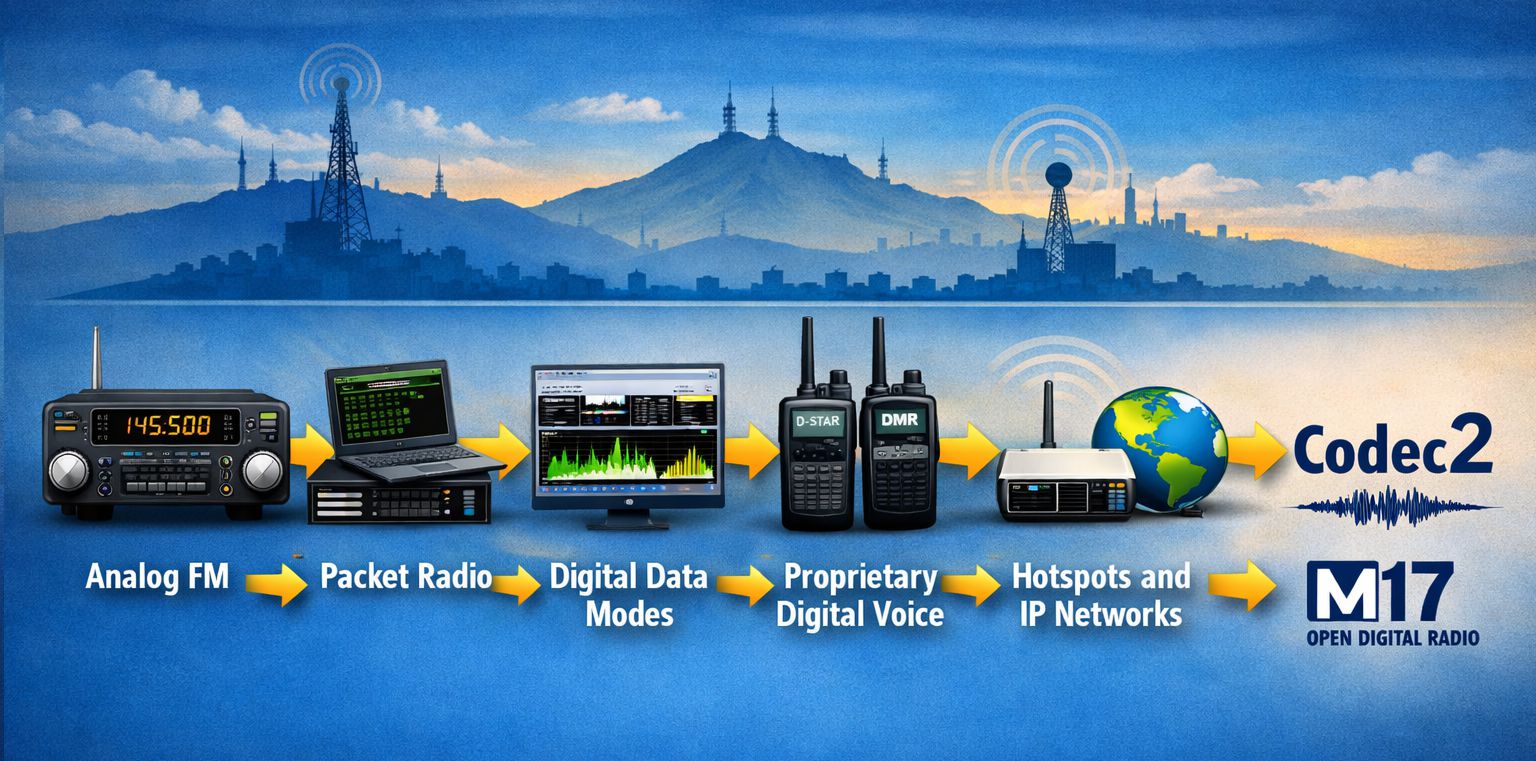
D-Star, DMR and C4FM represent three different answers to the same need: bringing voice communication into the digital age. Each of these systems has played an important role.
D-Star demonstrated that it was possible to imagine a digital network designed around the needs of amateur radio.
DMR showed how a technology born in the professional world could be reinterpreted and adopted on a global scale by the amateur radio community.
C4FM introduced an approach based on integration and ease of use, making digital voice accessible to a much broader audience.
None of these systems can simply be considered “better” than the others. Each represents a different design choice and responds to different requirements. After all, technology is always about compromises.
Efficiency, simplicity, openness, cost and adoption are elements that can rarely be maximized simultaneously.
The role of the network
The emergence of hotspots represented another fundamental step.
For the first time, digital radio communication separated two elements that had been closely connected for decades: the radio link and geographic distance.
Today, an operator can use a small personal device and access worldwide digital networks without necessarily depending on the presence of local infrastructure. It is an extraordinary possibility.
At the same time, it has confronted us with a question that goes beyond technology: what part of the communication must remain entrusted to the radio medium in order for it to still be considered amateur radio?
Again, there is no single answer. For some, the value lies in the continued presence of an RF component and in the use of tools created for radio communication. For others, the fascination of amateur radio lies precisely in the direct relationship with the transmission medium, with its limits and its physical characteristics.
The discussion remains open, and will probably continue to accompany the technological evolution of our hobby.
The return of openness
In this context lies the deeper meaning of Codec2 and M17.
Their value does not only consist in creating an alternative codec or protocol. The fundamental point is another one: demonstrating that technological openness is still possible even in the modern world of digital voice.
For many years we accepted the idea that some components had to remain closed because they were too complex or because they required significant industrial investments. Codec2 demonstrated that an open voice codec is possible. M17 extended this philosophy to an entire communication system.
This does not mean that proprietary technologies are wrong. That would be a simplistic and unfair conclusion.
Proprietary systems have brought innovation, reliability and a level of adoption that has allowed thousands of operators to approach digital voice.
The real issue is another one.
It is important that, alongside closed and commercially established systems, there continues to be room for open technologies where the community can study, experiment and contribute directly.
The meaning of amateur radio in the digital age
Perhaps the most important change introduced by digital voice does not concern audio quality or transmission efficiency.
It concerns the relationship between the user and the technology.
I have lived long enough in this hobby to have witnessed this change happen, not merely to be able to describe it. When I put the R0 repeater on Monte Pierfaone into operation in the 1980s, understanding the system was not an option: it was the only way to make it work. Every component – equipment, cavities, antenna system, propagation – was something I had to understand completely in order to intervene when something failed. Today, faced with a proprietary codec embedded inside a chip, that same question – “why does it work this way?” – no longer always has an answer available to the person asking it.
For generations of radio amateurs, the value of amateur radio activity has also been the ability to understand. Understanding how a transmitter works. Understanding why an antenna behaves in a certain way. Understanding how a signal manages to travel through space.
Modern technology has made many systems more complex, but it should not eliminate this possibility. Amateur radio has never been only about using a radio.
It has always also been about asking what is inside that radio and why it works.
A possible coexistence
The future of digital voice will probably not be represented by a single system destined to replace all others. D-Star, DMR, C4FM, M17 and other systems will likely continue to coexist, each with their own strengths and their own communities.
The real challenge will not be choosing the winner.
It will be maintaining a balance between two equally important needs.
On one side, the availability of modern, reliable and easy-to-use systems.
On the other side, the possibility of having technologies that are open, understandable and modifiable.
Because the greatest risk is not using a proprietary system. The greatest risk would be losing the ability to create new ones.
The final question
Digital voice has taught us that technological progress is not only a matter of performance. It is also a matter of culture.
Every new technology brings opportunities, but also choices. The question therefore is not: “What is the best digital system?”
The more important question is: “What future do we want to build for digital amateur radio?”
A future made only of increasingly complex and increasingly incomprehensible technologies?
Or a future in which there is still room for those who want to open a protocol, read a technical document, write a few lines of code and try a new idea?
Perhaps the answer lies precisely in the coexistence of these two worlds. Because amateur radio has never been defined by a particular modulation, a particular band or a specific piece of equipment.
It has been defined by curiosity.
And as long as we continue to ask ourselves how things work, to experiment and to build something new, digital voice will continue to be part of the same great tradition.