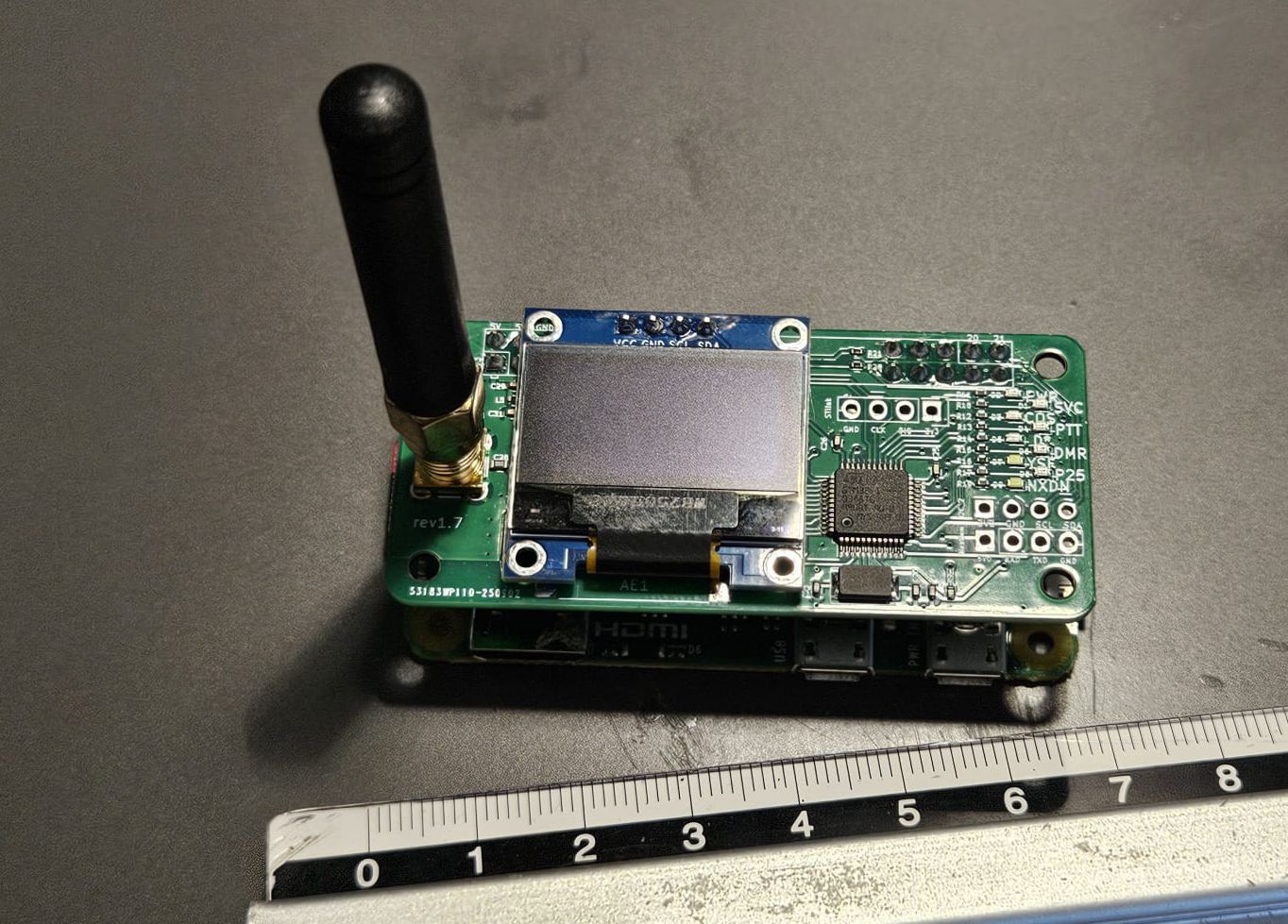
Hotspots: Radio as a Network Access Point
When we began this journey into digital voice communications, we saw that the transformation goes far beyond the way voice itself is transmitted. It involves the entire architecture of the system.
Voice is no longer simply modulated onto a radio carrier. It is converted into data, compressed, organized into packets, protected against transmission errors and finally transported through a combination of radio links and digital infrastructures.
With D-Star, DMR and C4FM we have examined three different ways of interpreting this transformation.
But there is another development that has profoundly changed the way these systems are used: the emergence of digital hotspots.
The hotspot is perhaps the point at which the transformation brought by digital voice becomes most evident, because it changes one of the fundamental concepts of traditional VHF/UHF communications: the relationship between radio, geography and distance.
From Repeaters to Personal Access Points
For decades, the operating model of VHF and UHF amateur radio communications remained essentially unchanged.
An operator uses a radio transceiver, the signal is radiated by the antenna and reaches either another operator directly or a repeater. Coverage depends upon the geographical position of the stations, the transmitted power, the characteristics of the antennas and the prevailing propagation conditions.
The repeater therefore represents a physical element of the landscape.
Its location is never arbitrary: a mountain peak, a tall building or a site with favorable propagation characteristics becomes strategically important because it allows communications to reach much farther.
In this model, radio is both the medium and the limitation.
With digital voice and the introduction of hotspots, this paradigm changes.
A hotspot is not simply a small personal repeater. Its primary purpose is not to increase radio coverage, but rather to provide an access point to a digital network.
The operator’s radio communicates with the hotspot through a local RF link, usually covering only a very short distance. The hotspot is then responsible for connecting that communication to the digital network used by the selected system.
The communication path therefore becomes something very different:
radio transceiver > hotspot > IP network > digital infrastructure > another node > radio transceiver
Radio remains part of the communication chain, but it is no longer the dominant element of the entire connection: it may cover only one or two segments measuring little more than a few tens of centimeters.
How a Hotspot Works
From a technical standpoint, a hotspot is a relatively simple device.
It generally consists of a small computing platform-often based on low-power embedded hardware-connected to a radio module compatible with the selected digital voice system.
Its task is to receive digital traffic from the operator’s radio, interpret it and forward it to the appropriate network.
The process works in the opposite direction as well: traffic coming from the digital network is received by the hotspot, converted back into the format required by the radio protocol and transmitted to the user’s transceiver.
From an operational perspective, the experience can seem almost identical to using a conventional repeater.
You select a Talk Group, a room or a reflector, press the PTT button and start speaking.
The difference lies entirely within the infrastructure that makes that communication possible.
Radio as a Network Terminal
The introduction of hotspots brings with it a very significant conceptual change.
In the traditional model, the repeater is a geographical entity. If I wish to communicate through a particular system, I must be within its coverage area.
A hotspot changes this relationship. The availability of a digital communication link no longer necessarily depends on the presence of local infrastructure. An operator can use a personal hotspot connected to a home network and gain access to digital systems distributed throughout the world.
This has had an enormous impact on the adoption of digital voice communications.
Many operators living in areas without digital repeaters have been able to experiment with D-Star, DMR or C4FM simply by building a small personal node.
From both a technical and functional perspective, this is an extremely effective solution.
It has democratized access to digital voice and enabled a level of adoption that would probably have been impossible if it had relied solely upon traditional radio infrastructures.
Yet this transformation also raises a deeper question.
Is It Still Amateur Radio?
The hotspot is probably one of the subjects that most divides the amateur radio community.
On one hand, it can be argued that it is simply a natural evolution of digital radio communications.
The operator uses a radio transceiver, transmits using RF modulation, employs a callsign and communicates through systems developed for amateur radio. The connection between the radio and the hotspot is still a genuine radio communication. From this perspective, a hotspot is nothing more than a new type of infrastructure, comparable in certain respects to a traditional repeater.
On the other hand, however, it is equally evident that a significant portion of the communication no longer takes place over the radio medium.
The distance between operators, propagation phenomena, RF link quality and many of the characteristics that have historically defined amateur radio communications assume a different role. The longest portion of the communication path may take place entirely over an IP network.
The question therefore arises naturally:
when the radio link represents only the final segment of a communication that relies on the Internet for most of its journey, are we still dealing with amateur radio communications, or are we entering a domain that is closer to digital networking services?
There is no single answer.
Personally, I have rather definite views on the matter. I have spent a lifetime building and maintaining real radio infrastructures-systems that work because of radio propagation rather than because they rely on an Internet service provider. I come from a time when the coverage of a repeater depended not upon a server, an ADSL connection or the availability of an external service, but solely upon physics, altitude, transmitted power and the quality of the installation itself. That was amateur radio in its fullest sense: confronting physical limitations, understanding them, overcoming them and optimizing their performance.
A hotspot, however technically interesting and useful for introducing newcomers to digital communications, asks none of this of the operator. There is no propagation to study and no physical limitation to overcome through ingenuity: there is simply a data connection that either works or does not work. It is apparent amateur radio rather than genuine amateur radio. It uses the tools and language of our hobby, but removes the very element that made it what it is: direct engagement with the radio medium itself.
The value of amateur radio has never resided solely in the technology employed, but also in the culture that has developed around it-experimentation, knowledge and the ability to understand the medium and overcome its limitations.
But, of course, everyone is free to answer this question as they see fit.
Every technological era brings new questions. The hotspot is simply the latest of them.
The Comparison with PoC Radio
The issue becomes even more interesting when we consider the rise of PoC communications-Push-to-Talk over Cellular.
In recent years, devices have become increasingly common that, from the user’s perspective, can appear remarkably similar to traditional radios. They feature a PTT button, support group communications, use terminology such as channels and Talk Groups, and allow instant communication between users separated by great distances.
The fundamental difference is that the primary communication medium is not radio frequency, but rather the cellular network or a Wi-Fi connection.
From the standpoint of the user experience, the difference may seem minimal. You press a button, speak and someone replies.
This comparison makes the questions raised by hotspots even more evident. What are the elements that truly define amateur radio communications? Is the mere presence of an RF component sufficient? Must the majority of the communication take place over the radio medium?
Or does the true value of amateur radio reside primarily in the community, the experimentation and the technical knowledge that surround the system?
Once again, the answer probably depends upon how each of us interprets the meaning of our hobby.
Strengths and Trade-Offs of Hotspots
From a practical standpoint, hotspots have introduced advantages that are difficult to dispute. They have made complex digital voice systems accessible even in the absence of local infrastructure, reduced the barriers to entry and fostered the creation of new operating communities. They have also become valuable tools for experimentation, allowing operators to better understand the functioning of digital networks.
There are, however, trade-offs.
Dependence upon Internet connectivity fundamentally changes our relationship with the radio medium. Communications through a hotspot may be extremely effective, but they are also dependent upon the availability of external infrastructures: data networks, servers, digital services and computing systems.
The limiting factor is no longer simply radio propagation, but the entire technological chain that makes the communication possible.
Technology and the Identity of Amateur Radio
A hotspot should therefore not be considered merely another accessory for digital voice communications.
It is the symbol of a much broader transformation.
Digital radio has progressively separated two elements that, for decades, had been inseparably linked: radio communications and geographical distance.
It has created extraordinary possibilities, enabling worldwide communications using small and inexpensive transceivers.
At the same time, it has prompted us to reflect upon the very meaning of amateur radio communications in the age of interconnected networks.
Perhaps the most interesting question is not whether a hotspot should or should not be considered amateur radio.
The more interesting question is which elements of amateur radio we wish to preserve when technology allows us to overcome almost all of the limitations that have historically characterized radio communications.
And it is precisely from this reflection that the next step in the evolution of digital voice emerges.
If networks can be open, if hardware can be accessible and if experimentation can once again take center stage, why should the most fundamental element of the communication chain-the conversion of voice into digital data-necessarily remain closed?
The answer to this question leads us toward the world of open codecs and toward those projects that seek to bring digital voice back within the original spirit of open amateur radio experimentation.
 Info
InfoThe title photograph shows the apparent simplicity of my own hotspot. It is based on a Raspberry Pi Zero equipped with a JumboSpot HAT. It is essentially a radio modem built around an STM32F405 microcontroller implementing the MMDVM (Multi-Mode Digital Voice Modem) protocol. The RF section incorporates a TCXO oscillator and provides adjustable output power of up to 100 mW. With the Raspberry Pi Zero H models, soldering is not even required.