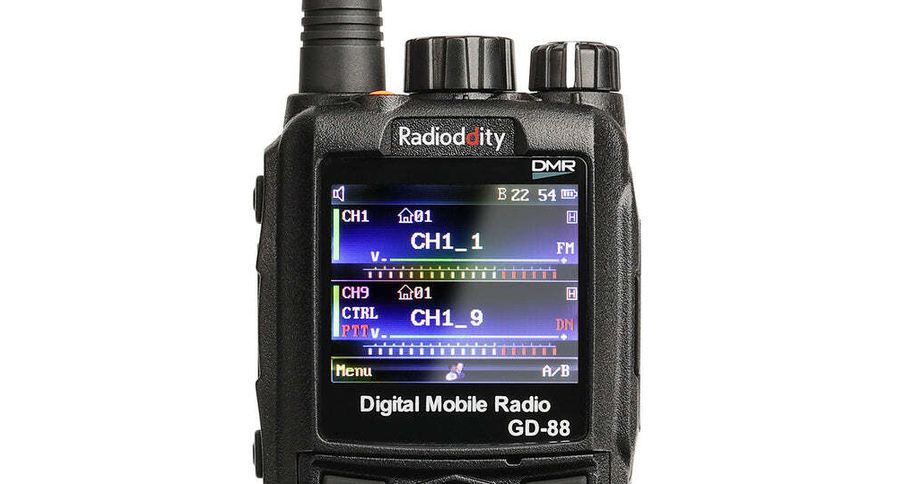
DMR: When Professional Conquered Amateur Radio
Among the three major digital voice systems currently used on VHF and UHF, DMR is undoubtedly the one that has achieved the widest adoption within the amateur radio community.
In many parts of the world, when an operator thinks of digital voice, DMR is often the first system that comes to mind. The availability of inexpensive equipment, the large number of installed repeaters and the existence of worldwide networks have transformed it into something of a lingua franca for digital communications in amateur radio.
Its origins, however, are very different from those of D-Star and C4FM.
DMR was not conceived as a technology for amateur radio, but as a professional standard intended for commercial and industrial communications. Its widespread adoption in our hobby is the result of a process of adaptation carried out by the amateur radio community, which successfully leveraged its capabilities and transformed it into one of the most widely used digital voice systems.
This particular history makes DMR one of the most interesting examples for understanding the relationship between commercial technology and amateur radio experimentation.
From Professional Networks to Amateur Radio Experimentation
DMR, Digital Mobile Radio, is a standard developed by ETSI with the goal of defining a digital radio system with publicly available specifications, primarily intended for professional applications.
The original objective was straightforward: to improve the efficiency of commercial and public radio communications by offering more services than traditional analog FM without requiring a complete replacement of existing infrastructure.
The most important feature introduced by DMR is its use of TDMA technology, or Time Division Multiple Access.
Instead of continuously occupying the radio channel with a single communication stream, DMR divides the channel into two separate time intervals, called slots. Each slot can carry an independent communication, effectively providing two logical channels within a single physical frequency.
This solution represents one of the system’s greatest advantages: significantly improved spectrum efficiency.
How a DMR Communication Works
From the perspective of the digital processing chain, DMR follows the same general principles as other digital voice systems.
The audio signal captured by the microphone is converted into digital form, compressed using a voice codec, encapsulated within a structured data stream and subsequently transmitted over the radio channel.
DMR also employs a codec belonging to the AMBE family—in particular AMBE+2—which provides good voice quality at very low data rates.
As we have already seen with D-Star and C4FM, however, this raises the issue of technological openness. The fact that the DMR standard is publicly documented does not imply that all of its components are freely implementable.
The voice codec remains proprietary technology and is a fundamental part of the communication chain.
It is therefore important to distinguish between two concepts that are often confused: a standard may be open in terms of its protocol definition while still containing proprietary components required for a complete implementation.
The Talk Group Concept
One of the elements that has contributed enormously to DMR’s success in amateur radio is the concept of Talk Groups.
Unlike traditional FM communications, where the fundamental concept is the channel or frequency, DMR traffic is also organized through logical conversation groups.
A radio amateur can therefore use a local repeater to participate in a national or international conversation simply by selecting the appropriate Talk Group.
This feature has profoundly changed the way digital repeaters are used. A frequency no longer necessarily identifies a particular geographical area or a specific user community; instead, it becomes an access point to a much larger network.
The Rise of DMR Networks
The explosive growth of DMR in amateur radio has been made possible by the creation of large interconnected networks.
Systems such as BrandMeister and similar infrastructures have created worldwide networks in which thousands of repeaters can exchange traffic in real time.
The result is an operating experience that differs significantly from traditional analog radio.
An operator using a DMR handheld transceiver can connect to a local repeater and communicate with radio amateurs on the other side of the world using a combination of radio frequency and IP networking.
Once again, the repeater is no longer merely an RF device, but a node within a distributed digital infrastructure.
Codeplugs: The Power and Complexity of DMR
One of the most distinctive aspects of DMR is the programming of radio equipment.
The term “codeplug” has become almost synonymous with DMR in the amateur radio world. It refers to the complete set of parameters that define the radio’s behavior, including frequencies, contacts, Talk Groups, time slots, zones and numerous other settings.
This flexibility is one of the system’s greatest strengths, but it also represents one of the biggest challenges for newcomers to digital voice.
A DMR radio rarely operates simply by setting a frequency and pressing the PTT button. To fully exploit its capabilities, it is necessary to understand the underlying logic of the system.
From this perspective, DMR is probably the digital voice system that most clearly demonstrates the transformation of radio communications into an information technology.
Strengths and Trade-Offs of DMR
DMR’s greatest strength is undoubtedly its widespread adoption. The large number of available radios—often at very affordable prices—has enabled countless operators to enter the world of digital voice.
Its TDMA architecture also makes extremely efficient use of available spectrum, while the existence of large worldwide networks enables communications that would be impossible using only local infrastructure.
Its greatest compromise is complexity.
DMR requires a greater understanding of its internal mechanisms than some other systems and may feel less intuitive for operators coming from traditional FM.
This is compounded by its dependence on network infrastructures, the use of a proprietary voice codec and a design philosophy that originated from professional requirements rather than amateur radio traditions.
Technological Openness
| Component | Status |
|---|---|
| Base standard | Public (ETSI) |
| Complete protocol | Partially documented |
| Voice codec | Proprietary (AMBE+2) |
| Alternative software implementations | Possible |
| Completely open hardware implementations | Limited |
| Possibility of building a complete system without proprietary components | No |
Limitations in Amateur Radio Applications
One of the most interesting technical aspects of DMR is directly related to its professional origins.
The TDMA architecture requires precise time synchronization between transmitter and receiver. Every radio must adhere with great precision to the time intervals assigned to the two slots.
This introduces certain theoretical limitations related to radio signal propagation.
Because the repeater must correctly receive and process the time-slot packets transmitted by remote stations, there is a theoretical maximum distance beyond which propagation delay can become significant relative to the timing windows defined by the protocol.
In everyday amateur radio operation, this limitation is rarely a practical problem because typical communication distances remain well below the critical threshold. Nevertheless, it provides an interesting example of how a design choice originally intended to optimize professional communications introduces specific characteristics in amateur radio applications as well.
A practical example that I experienced personally illustrates this point. In the 1980s, when I commissioned the R0 repeater on Monte Pierfaone, its analog coverage routinely extended to the northern coast of Sicily, providing communication ranges exceeding 300 kilometers. With DMR, the same infrastructure is effectively limited by the system’s timing constraints to less than 200 kilometers.
Other limitations are more evident: the need for careful radio programming, strong dependence on network infrastructures and poor direct interoperability with other digital voice systems.
A Professional Technology Adopted by Amateur Radio
The success of DMR demonstrates something rather interesting: a technology does not necessarily need to originate within amateur radio to be embraced by the community.
The amateur radio world took a professional communications standard, adapted it to its own requirements and built around it one of the largest digital networks ever created.
This is probably DMR’s greatest strength, but also its most controversial aspect.
On one hand, we have a system that is widespread, affordable and highly functional. On the other hand, we have a technology developed with objectives quite different from the historical principles of amateur radio experimentation.
DMR is therefore perhaps the clearest symbol of the compromise that characterizes modern digital voice communications: powerful, efficient and accessible systems built upon technological foundations that are not completely open.
And it is precisely this balance between practicality and openness that makes the comparison between D-Star, DMR and C4FM so interesting: three different answers to the same question.
How should digital voice communications in amateur radio be designed?