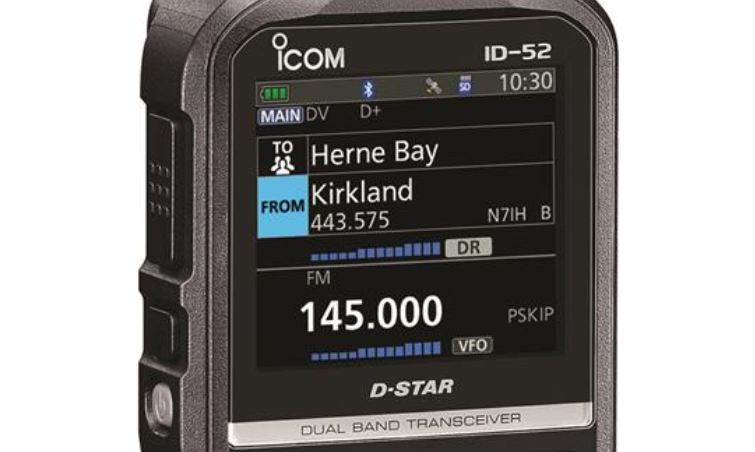
D-Star: Digital Voice Designed for Amateur Radio
When discussing digital voice in amateur radio, D-Star occupies a special place in history. Today, its name is often associated with a “niche” system, especially when compared with the widespread adoption of DMR, but this view risks overlooking its true significance.
D-Star was the first major VHF/UHF digital voice system designed specifically for amateur radio, with the goal of doing more than simply replacing analog modulation. It introduced a new way of thinking about communication between radio amateurs.
The acronym D-STAR, Digital Smart Technologies for Amateur Radio, already encapsulates the philosophy that guided its development. The idea was not simply to adapt a professional technology for amateur radio, but to build an infrastructure in which voice, data and operator identity could coexist within a single digital system.
The project originated in the early 2000s through the Japan Amateur Radio League (JARL), which launched a research and development program aimed at defining a digital standard specifically tailored to the needs of the amateur radio service. This initiative led to the creation of a system that would later be adopted and commercialized primarily by Icom, becoming the first widely deployed example of amateur digital voice in the VHF and UHF bands.
The difference between D-Star and the systems that followed is evident from its design philosophy.
D-Star was not conceived as a professional radio technology adapted for amateur radio, but rather as a technology in which concepts that are fundamental to our hobby are integrated directly into the protocol. The operator’s callsign, for example, is not merely a piece of information displayed on the radio’s screen, but an integral part of the communication routing system.
This is probably one of the most fascinating features of D-Star.
In a conventional analog communication, we think in terms of frequencies: I select a repeater, set the appropriate channel and transmit. With D-Star, this concept changes radically. The central question is no longer simply where the radio is located, but rather who I want to reach.
The callsign therefore becomes a kind of digital address.
When a radio amateur establishes a D-Star communication, the system can use this information to determine the communication path and route it through the network of interconnected repeaters. It is a concept that anticipated by many years the idea—now common in other systems—of identifying the user rather than merely the radio access point.
From this perspective, D-Star probably represents the most interesting attempt to bring a deeply amateur-radio-oriented concept into digital communications: the operator’s identity.
Digital Voice in D-Star
From a technical standpoint, voice follows the same general path as in all digital voice systems.
The audio captured by the microphone is converted into digital data, compressed by a voice codec, encapsulated within a structured communication stream and subsequently modulated onto the radio carrier.
The codec used by D-Star belongs to the AMBE family, a proprietary technology developed by Digital Voice Systems, Inc. This choice provides excellent voice compression efficiency, making it possible to transmit intelligible audio using a very low data rate.
At the same time, however, it introduces one of the system’s most controversial aspects.
Although D-Star was designed for amateur radio and embodies a philosophy that closely reflects the spirit of the hobby, it is not completely open. The radio protocol is now sufficiently documented to allow alternative software and hardware implementations, but not every component is open. D-Star’s routing software has historically been proprietary to Icom. Alternative implementations have been developed through community-driven reverse engineering efforts rather than complete official documentation. And, last but not least, the voice codec itself remains proprietary.
This is precisely what makes D-Star a perfect example of the digital voice paradox: a system designed for an environment founded on technical experimentation that relies on a fundamental component that cannot be freely implemented.
A Network, Not Just a Repeater
One of the most innovative concepts introduced by D-Star is that of a digital amateur radio network.
A traditional analog repeater receives a signal and retransmits it. A D-Star node, on the other hand, is an element of a distributed infrastructure capable of exchanging information with other nodes through network connections.
This architecture makes it possible to establish links between geographically distant repeaters, use shared reflectors and create worldwide distributed operating communities.
Although the operator may simply be using what appears to be a conventional VHF or UHF radio, they are in fact operating within a system where radio frequency and IP networking work together.
It is precisely this integration between radio and computer networking that characterizes the birth of modern digital voice communications.
Voice and Data: A Modern Approach
Another distinctive feature of D-Star is the importance given to data transmission from the very beginning.
The system was not designed merely to replace analog voice communications, but to provide a digital channel capable of transporting additional information. This reflects a vision in which radio is no longer simply a means of transferring voice, but a general-purpose communications system.
Today this philosophy may seem perfectly natural, but in the early 2000s it represented a significant conceptual leap.
Strengths and Trade-Offs of D-Star
D-Star’s greatest strength is probably the fact that it was conceived with a strong amateur-radio identity. The role of the callsign, communication routing and the integration of voice and data demonstrate a design philosophy in which the radio amateur is not merely an end user, but a central element of the system.
From an operational standpoint, it offers an elegant and flexible architecture that is particularly attractive to those who appreciate the technical and experimental aspects of digital communications.
Its principal compromise is the proprietary AMBE codec, which limits the possibility of creating completely open implementations. Added to this are its lower adoption rate compared with DMR in many parts of the world, a more limited selection of commercially available equipment and a steeper learning curve resulting from the system’s greater conceptual complexity.
D-Star requires radio amateurs to understand mechanisms that other systems often hide behind simpler configuration procedures.
Technological Openness
| Component | Status |
|---|---|
| Communication protocol | Documented |
| Voice codec | Proprietary (AMBE) |
| Alternative software implementations | Possible |
| Completely open hardware implementations | Limited |
| Possibility of building a complete system without proprietary components | No |
Limitations in Amateur Radio Use
From an operational perspective, D-Star’s principal limitation is not a technical characteristic of the protocol, but rather its adoption. A digital system ultimately thrives on the community that uses it: the availability of repeaters, reflectors and fellow operators often determines the practical usefulness of a technology.
Compared with other systems, D-Star also requires a better understanding of routing concepts and configuration procedures. This may represent a barrier for newcomers to digital voice, but at the same time it is one of its most interesting aspects for those who wish to understand what actually happens behind a simple press of the PTT button.
A Milestone in Digital Voice Communications
D-Star is not the most widespread digital system today, nor is it necessarily the simplest to use. Its historical importance, however, remains unquestionable.
It was the first large-scale attempt to envision a digital voice system designed around the needs of amateur radio operators, introducing concepts such as digital identity, callsign-based routing and the integration of radio communications with network infrastructures.
For this reason, it represents a fundamental milestone in understanding the evolution of digital voice communications in the VHF and UHF bands.
In the next articles, we will see how two other systems followed very different paths: C4FM/System Fusion, which reflects the design philosophy of a major amateur radio equipment manufacturer, and DMR, which originated in the professional communications market and was subsequently adopted by the amateur radio community.
D-STAR is a registered trademark of Icom Incorporated.