PSK31
PSK31 is one of the most iconic digital modes of the computing era in amateur radio, born during a period when personal computers were becoming common tools in radio stations. Unlike older modes such as RTTY, which derive directly from electromechanical technologies, PSK31 is a “native digital” mode: designed from the outset to exploit PC computing power and sound card precision. It was introduced in the late 1990s through the work of Peter Martinez, G3PLX, who sought an operating mode capable of combining spectrum efficiency, low symbol rate, and text readability, while maintaining an operator-to-operator interaction similar to CW or RTTY.
From a historical perspective, PSK31 emerged in response to two major needs felt by radio amateurs at the time: reducing occupied bandwidth and improving decoding under noisy and fading conditions. Earlier digital modes, while effective, were often constrained by legacy hardware limitations (such as teletypes) or required relatively wide bandwidths. Martinez proposed a completely different approach: using an extremely efficient Phase Shift Keying (PSK) modulation and a very low symbol rate of 31.25 baud, chosen not for historical reasons but for a practical one. At 31.25 baud, each symbol lasts 32 milliseconds-a value that aligns perfectly with the 8000 Hz audio sampling rate of contemporary sound cards, greatly simplifying signal generation and decoding.
The core of PSK31 is BPSK (Binary Phase Shift Keying), in which information is encoded as phase changes in an audio tone. Unlike RTTY, which alternates between two distinct frequencies, PSK31 uses a single continuous tone whose phase is inverted to represent bits. This allows a drastic reduction in bandwidth: a properly configured PSK31 signal typically occupies about 60 Hz, an order of magnitude narrower than RTTY’s ~250 Hz. There is also a more robust variant, QPSK31, which uses four phase states and includes Forward Error Correction (FEC), making it more resistant to noise and QRM, albeit at the cost of increased decoding complexity.
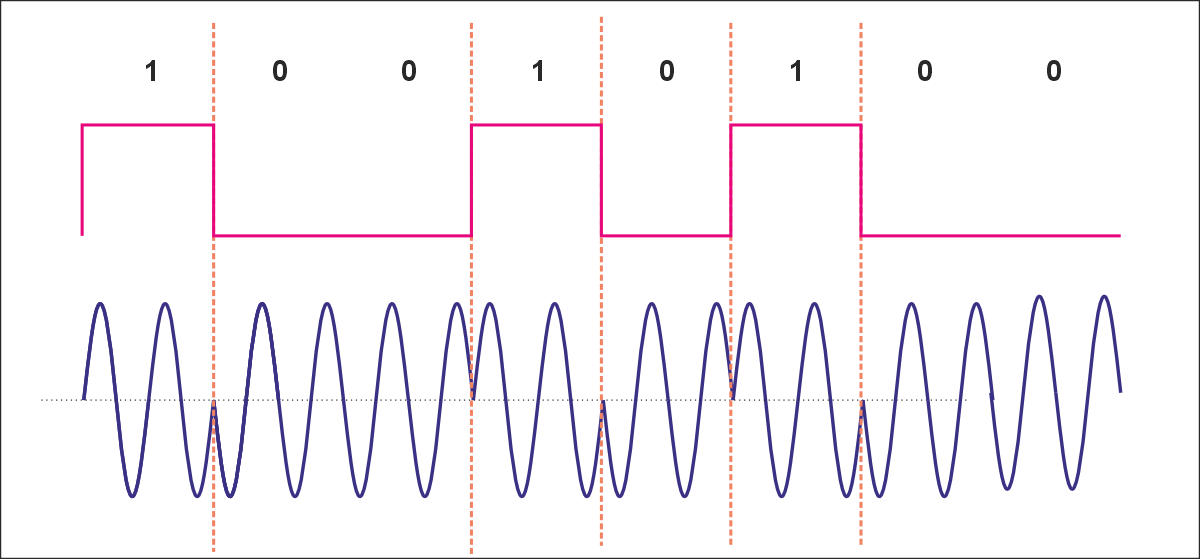
A fundamental element of PSK31 is its transmission alphabet, based on the Varicode system, a variable-length encoding in which frequent characters (such as vowels or spaces) are represented with shorter sequences, while rare characters use longer ones. Inspired by data compression principles, this design allows a surprisingly high perceived communication speed despite the low symbol rate. In practice, a PSK31 QSO can feel almost as fluid as RTTY, while occupying a much narrower bandwidth and requiring a significantly lower signal-to-noise ratio.
From an operational standpoint, PSK31 is characterized by its sensitivity. Thanks to phase modulation and extremely narrow bandwidth, it is possible to decode signals that are barely audible, often near the noise floor. This has made PSK31 a favorite among QRP operators: with just a few watts, or even sub-watt power levels, it is possible to establish intercontinental contacts under favorable conditions. The downside of this sensitivity is vulnerability to audio overload, intermodulation distortion (IMD), or excessive power: a “dirty” PSK31 signal can interfere with many adjacent QSOs due to its extremely narrow spectral footprint.
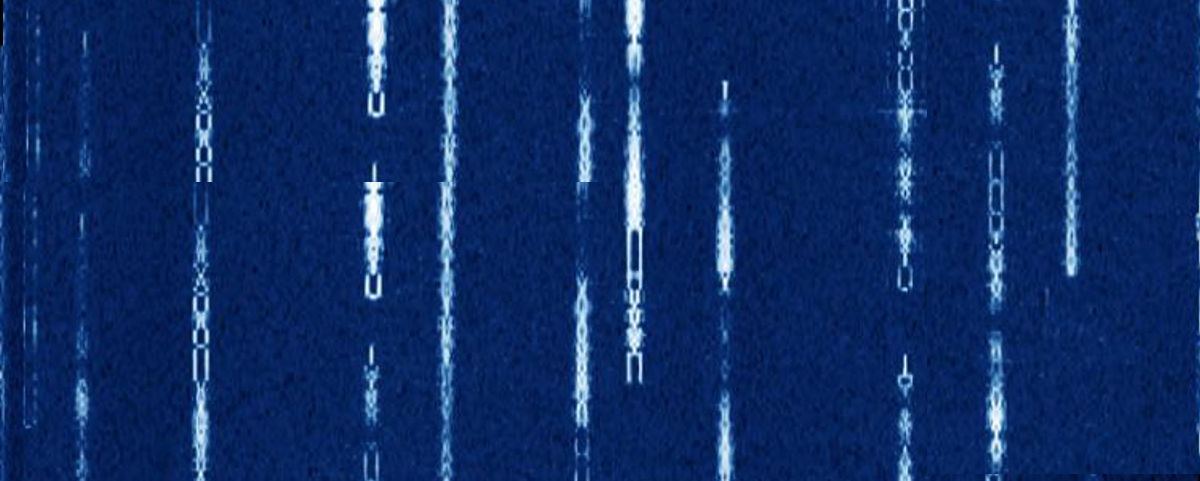
Technically, signal generation is almost always performed via AFSK: software produces a continuous audio tone (typically around 1000–1500 Hz) modulated in phase, which is then fed into an SSB transmitter. On reception, software analyzes the phase of the tone and reconstructs the bitstream. Unlike RTTY, where tuning is relatively forgiving, PSK31 requires very precise centering: even a few hertz of offset can degrade decoding performance, especially in BPSK. This is why digital waterfall displays show PSK31 signals as extremely thin vertical traces-precision is an intrinsic part of the mode.
An often overlooked aspect is the waveform shaping of PSK31. To prevent phase transitions from generating spurious emissions or spectral splatter, Martinez introduced a technique called raised cosine shaping, which smooths phase transitions. This is crucial for maintaining spectral purity and allows many QSOs to coexist within the same band segment. It is no coincidence that PSK31 segments, such as 14.070 MHz on 20 meters, are often filled with dozens of tightly packed signals, each only a few hertz wide.
Beyond the original mode, PSK31 spawned a family of derivatives that extend its capabilities while preserving its core philosophy. The most notable is QPSK31, which uses four phase states instead of two. This enables a simple Forward Error Correction mechanism, improving resilience against impulsive noise and interference. Another widely used derivative is PSK63, which doubles the symbol rate to 62.5 baud. Its faster perceived speed makes it ideal for contests, quick exchanges, or more dynamic QSOs, while still maintaining a narrow bandwidth. Other variants include PSK125, even faster but more noise-sensitive, and experimental multi-tone modes designed to fully exploit modern sound card capabilities. All these modes share the same design philosophy: maximizing spectral efficiency and text readability while adapting speed and robustness to operational needs.
With the rise of newer modes such as FT8, PSK31 has lost some popularity, but it still holds an important place in contemporary amateur radio. Unlike minimal-exchange modes, PSK31 retains a conversational character: it supports full QSOs, information exchange, and real operator-to-operator dialogue. It remains a mode that still requires a degree of skill-especially in audio level control and power management-and rewards technical precision. For many operators, it represents an ideal balance between efficiency, interactivity, and simplicity.
In summary
PSK31 is a digital mode that perfectly embodies the transition of amateur radio into the computer era: a system designed with modern principles, capable of fully leveraging digital processing, while still preserving the spirit of traditional QSOs. Its combination of narrow bandwidth, high sensitivity, efficient encoding, and human interaction makes it one of the most elegant and technically refined modes available on HF bands today.
 Info
InfoPSK31 and its derivatives are supported in HamLinux by FlDigi