RTTY
RTTY (Radio Teletype) is one of the most historic and fascinating digital modes in the world of amateur radio. It originates from the adaptation of electromechanical teleprinters to radio transmissions, systems developed from the second half of the 19th century for transmitting text over wired lines. The transition to radio began in the early decades of the 20th century, but it was especially during the Second World War that RTTY saw widespread use for military and diplomatic communications, thanks to its reliability and its ability to transmit text that could be automatically printed on paper.
In amateur radio, RTTY became popular starting in the 1950s and 1960s, when surplus military teleprinters became available on the civilian market. These devices, often large and noisy, used the Baudot code (in its ITA2 version), a 5-bit serial transmission that allows the representation of letters and numbers-grouped into two sets (FIGS, LTRS)-through sequences of electrical impulses. Unlike Morse code, which requires a human operator for encoding and decoding, RTTY is fully automated; it is decoded by the teleprinter, which represented a true revolution for its time.
From a technical standpoint, RTTY is a digital modulation based on Frequency Shift Keying. In practice, the transmitter alternates between two audio frequencies (mark and space) to represent binary states 1 and 0. In modern amateur radio systems, a variant called AFSK (Audio Frequency Shift Keying) is often used, where tones are generated at audio level and then modulated onto a fixed-frequency SSB (Single Side Band) carrier. The most common configurations use a speed of 45.45 baud and a 170 Hz shift, parameters that have become a de facto standard in amateur radio.
These two parameters have a well-defined origin.
The 45.45 baud rate was not chosen for “radio” reasons, but comes directly from Baudot-based teleprinters. Those machines were designed to operate at around 60 words per minute (WPM), and the entire system-gears, synchronous motors, timing mechanisms-was built to sustain that rate. Each character consists of 1 start bit, 5 data bits, and 1.5 stop bits, for a total of 7.5 bits per character; at 45.45 baud, this corresponds to about 6 characters per second, or roughly 60 WPM: fast enough for smooth communication, yet slow enough to ensure reliability with electromechanical components. When RTTY was adapted to radio, this parameter was simply “carried over” and proved ideal for HF propagation as well: a moderate speed that tolerates noise, fading, and interference well.
The same applies to the 170 Hz shift. From a modulation standpoint, RTTY uses Frequency Shift Keying, meaning two distinct frequencies (mark and space) represent binary states. In professional and military systems, much wider shifts were used (typically 425 or 850 Hz), because the priority was robustness over often difficult radio or wired circuits. Amateur radio operators, however, working in crowded HF bands, progressively adopted a narrower shift of 170 Hz, which represents an extremely effective compromise: wide enough to clearly distinguish the two states, but narrow enough to keep the overall bandwidth within about 250 Hz, perfectly compatible with SSB filters.
From an operational point of view, this combination produces a very characteristic signal: two stable audio tones, separated by 170 Hz, continuously alternating. In modern AFSK systems, these tones are typically centered around 2125 Hz (mark) and 2295 Hz (space), generated by software and then transmitted through a standard SSB chain. On reception, software analyzes the audio spectrum and reconstructs the bit sequence.
Here an interesting and often unintuitive aspect comes into play: why it is possible to decode RTTY even when only one of the two tones is “properly” received. In theory, RTTY is a differential system: information is contained in the transition between mark and space, so both frequencies would be required. In practice, however, receiver behavior and filtering make the situation more nuanced. When tuning an RTTY signal, even if only one tone is clearly “locked” (for example, due to incorrect shift), modern demodulators do not rely solely on absolute amplitude. The resulting signal, even if incomplete, still preserves a coherent temporal structure (start/stop sequence and bit timing). In other words, even when mainly observing one tone, the decoder can often still detect state transitions. Practically speaking, it is like “seeing the shadow” of the missing tone: not perfect, but often sufficient to reconstruct the text, especially with strong signals.
This explains typical operating situations: RTTY signals decodable even with imperfect tuning, successful reception with narrow or misaligned filters, and dramatic improvement simply by correctly centering both tones. Naturally, for optimal decoding both tones should be clearly visible and symmetric. Under difficult conditions (QRM, selective fading), one tone may be heavily attenuated compared to the other: in such cases RTTY often still works, but with increased error rates.
And it is precisely this imperfect yet surprisingly effective tolerance that has contributed to the longevity of RTTY. The combination of 45.45 baud and 170 Hz is not just a historical standard: it is a balance point that allows the system to “hold up” even when real-world conditions are far from ideal, which in HF happens almost all the time. However, it also has clear limitations: it occupies relatively wide bandwidth compared to more modern digital modes and does not include error correction mechanisms. This means that incorrect characters can appear in received text without automatic recovery.
With the advent of computers in the 1980s and 1990s, RTTY underwent a major transformation: mechanical teleprinters were gradually replaced by dedicated software, interfaced with radios via simple audio modems or sound cards. Programs such as MMTTY made RTTY accessible to a much larger number of amateur radio operators, eliminating the need for bulky hardware.
From an operational perspective, RTTY is still widely used today in amateur radio contests, where speed and automation allow a large number of contacts in a short time. There are also dedicated competitions, such as the RTTY Roundup organized by the American Radio Relay League (ARRL), which demonstrate the vitality of this operating mode despite its age.
In summary
RTTY represents a bridge between analog radio and modern digital communications: a system born more than a century ago, adapted to radio in a wartime context, and later adopted by amateur radio operators as one of the first true digital modes. Even today, despite the existence of more advanced techniques such as PSK31 or FT8, RTTY retains a special charm, made of history, simplicity, and that characteristic “sound” that makes it immediately recognizable on the bands.
 Info
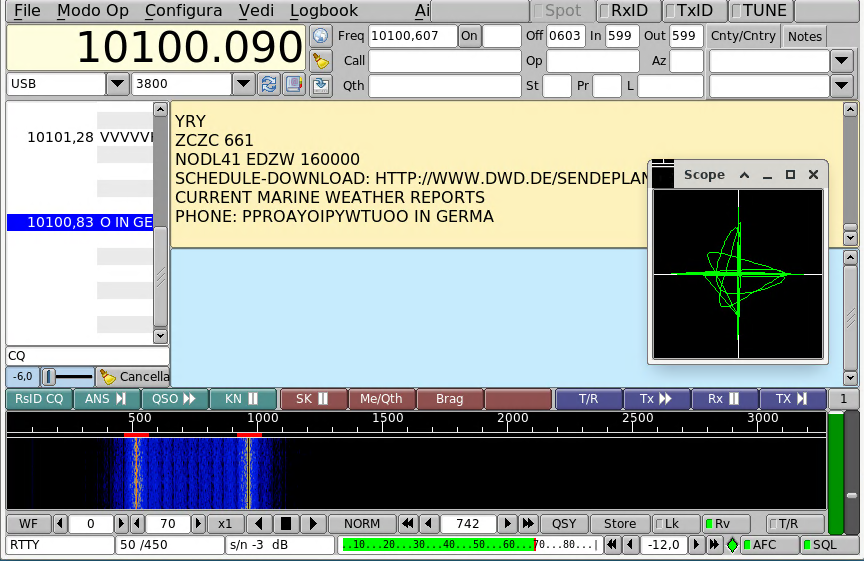
InfoIn HamLinux it is possible to use FLdigi (shown in the title image) to operate in RTTY. From the “Mode” menu you can select the most common modes, or manually set parameters via the “Custom” option (translated as “Other” in the Italian interface).
Through the “TX” menu it is possible to define speed and shift even for transmissions that do not follow standard conventions-such as in the example shown, where the DDK9 weather station transmits on 10100 kHz at 50 baud with a 450 Hz shift and inverted polarity (indicated by the “Rv” option at the bottom right).
The waterfall allows easy tuning of the station by aligning the markers (red lines) with the received signals; it also visually helps verify whether the configured shift is correct. An additional aid is provided by the X-Y scope, which indicates correct tuning by displaying mark and space signals on the two crossed axes-similar to old cathode-ray modem displays-where correct adjustment produces a cross-shaped figure.