After becoming familiar with basic modulations-amplitude, frequency, and phase-we took a fundamental first step: we understood that a radio signal can be shaped to carry information. So far, however, we are still in a world where everything varies continuously, much like speech or music.
When we enter the field of digital modes, the paradigm changes.
It is no longer about faithfully following a waveform that varies over time, but about transmitting information in the form of well-defined states, which can still be recognized in the presence of noise, fading, and the typical disturbances of radio communications. And this is exactly where two key concepts come into play: the symbol and the constellation.
A symbol, in the digital context, is something very concrete: it is how the signal appears over a given time interval. We can think of it as a sort of letter in the radio alphabet. During each symbol interval, the transmitter sets the carrier to a specific combination of amplitude, phase, and/or frequency-and that combination represents information.
At this point it is important to clarify a fundamental distinction: that between bit and symbol. A bit is the smallest unit of information (0 or 1), while the symbol is what actually travels over the radio channel. A symbol can represent one or more bits, depending on how many distinct states we are able to transmit and distinguish. In general, with M possible symbols we transmit log₂(M) bits per symbol: 2 symbols → 1 bit, 4 symbols → 2 bits, 8 symbols → 3 bits, and so on.
This distinction is crucial because it introduces a very important operational concept: we do not increase data rate only by sending symbols faster, but also by making each symbol carry more information. This is exactly where modulations become more complex.
The rate at which symbols are transmitted is measured in baud (symbols per second), while the information throughput-which is what we really care about-is measured in bit/s. The two values are equal only when each symbol carries a single bit: this is the case, for example, of classic RTTY at 45 baud, where each symbol corresponds to one bit. With more complex modulations, the same 45 baud become a multiple of bit/s: with 4 possible symbols, 45 baud already correspond to 90 bit/s. This is a concept well known to those who worked with old HF modems, even if not always under this name.
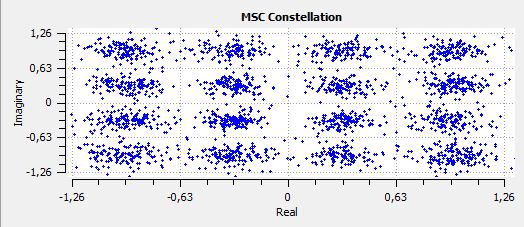
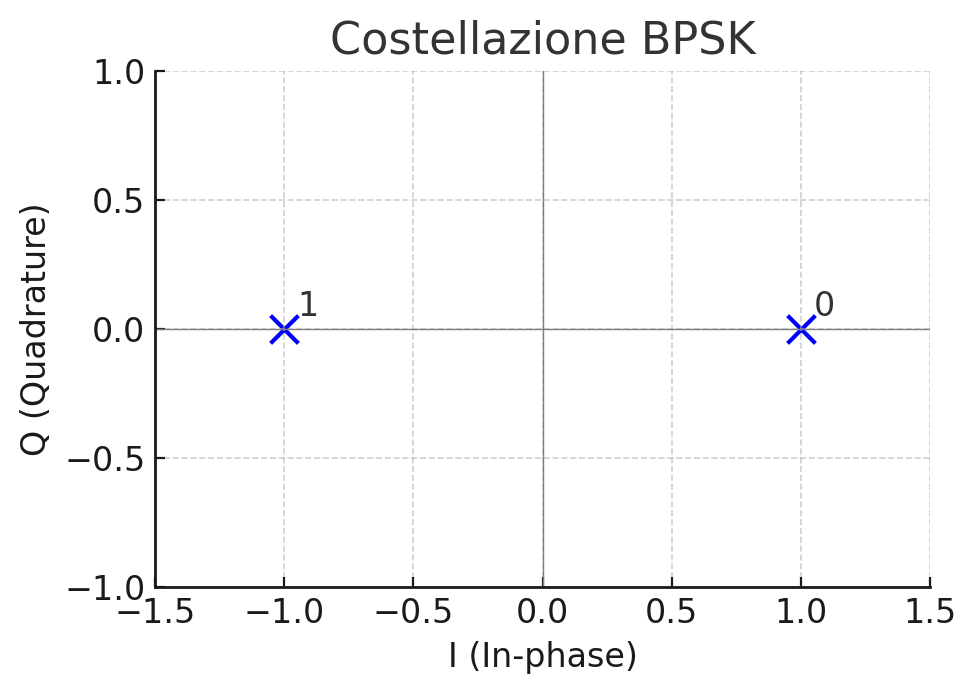
To visualize and organize these symbols, we use the constellation: a graphical representation in which each symbol is a point on a plane defined by two axes-the in-phase component (I, from In-phase) and the quadrature component (Q, Quadrature). In this space, each point describes exactly the amplitude and phase required to transmit that specific symbol.
Looking at a constellation1, the trade-off becomes immediately clear: few well-separated points mean robustness; many closely packed points mean higher efficiency but also greater sensitivity to noise. It is the classic balance every radio amateur knows well when working on HF: weak signals and narrow bandwidth favor simple schemes, while better conditions allow for “denser” modulations.
And it is precisely this transition-from bit to symbol, and from continuous variation to a finite set of states-that brings us close to one of the deepest concepts in communication theory: Shannon’s theorem. Without going into mathematical detail, this theorem establishes the theoretical maximum amount of information that Shannon theorem we can transmit over a channel, given its signal-to-noise ratio and available bandwidth. In words: doubling bandwidth or improving SNR increases channel capacity, but in a logarithmic way-each further “step” costs increasingly more resources. To give a concrete idea: increasing SNR from 10 dB to 20 dB does not double capacity, but increases it by a bit more than half. Reaching 30 dB adds even less. This is why chasing QAM-1024 on HF makes little sense: the gain in bit/s requires an SNR improvement that ionospheric conditions rarely provide.
Modern digital modulations, working with increasingly sophisticated symbols and constellations, try to approach that limit. By increasing the number of symbols (i.e., the density of the constellation), more bits per second can be transmitted within the same bandwidth.
But the cost is clear: a cleaner signal, better stability, higher transmitter linearity, and more advanced reception techniques are required. High-density constellations such as QAM-64 or QAM-256 are in fact very sensitive to amplifier non-linearities: a distortion that would be almost negligible in BPSK can seriously compromise reception in a denser scheme. The reason is geometric: in amplitude-varying modulations, compression or saturation of the amplifier shifts constellation points away from their ideal positions-and symbols that should be clearly separated become ambiguous to decode. This is why constant-envelope modulations like BPSK and FSK are preferred on HF and satellite links with high-efficiency amplifiers, while QAM finds its ideal environment in systems where linearity is controlled, such as fiber backbones or digital terrestrial broadcasting.
In other words, the entire evolution of digital modulation can be seen as a continuous attempt to push as close as possible to that theoretical limit, without being overwhelmed by noise.
Digital modulations introduce nothing “magical”: they use exactly amplitude, phase, and frequency of the carrier, but organize them into a discrete language made of well-defined symbols, optimized to carry information as efficiently as possible.
With these tools-symbols, bits, baud, and constellations-we can finally approach more common modulations used in digital modes: from FSK (Frequency Shift Keying), used for example in classic RTTY, to PSK (Phase Shift Keying) and QAM (Quadrature Amplitude Modulation). We will understand not only how they work, but also why they are chosen depending on operating conditions.
And from here, the step toward the digital modes we use every day in the station is truly short.
 Info
Info