Why there is a need to divide time
When multiple signals must share the same channel, they do not necessarily need to be separated in frequency. If bandwidth is limited, or if the data streams do not need to be active simultaneously, another equally valuable resource can be exploited: time.
The idea is intuitive. Instead of transmitting everything at once on different frequencies, transmission is performed in turns on the same frequency. Each stream is assigned a dedicated time interval—a moment in which the channel belongs to it alone and no one else can use it. When its turn ends, the channel moves on to the next stream, and so on in a continuous cycle. This principle is known as Time Division Multiplexing, or TDM.
TDM: the basic structure
One can imagine the radio channel as a narrow one-way alternating road. You cannot let two cars pass at the same time, but you can let them pass one at a time, regulating traffic with a traffic light. In TDM, the channel is the road, the streams are the cars, and the time slots are the green lights of the traffic signal. Separation does not occur in the frequency domain, but in the time sequence: the channel is single, but it is divided into regular time windows, and each window is assigned to a stream or user. Only the entity assigned to that slot can transmit at that moment. The result is that a single channel can serve many streams, provided that none of them requires continuous bandwidth usage.
From TDM to TDMA
When time slots are not used to carry internal streams within a system but are instead assigned to independent users, the principle is called TDMA (Time Division Multiple Access). The distinction is functional rather than technical: TDM is the division of time among streams; TDMA is the division of time among users. It is worth noting that in the literature the two terms are sometimes used interchangeably, especially in industrial and embedded systems; however, the distinction is useful for clarifying context. In a TDMA system, each user is assigned a recurring slot and must respect strict time synchronization. If the slot has just passed, the user must wait for the next cycle. It is a simple concept, but one that requires precise and rigorous time management.
A direct analogy: voice QSOs
The behavior of radio amateurs in voice communication is, in practice, a natural form of TDMA. Everyone is on the same frequency, but only one person speaks at a time. The others listen, wait, and when the first operator finishes, they hand over the turn with an “over.” There is no rigid synchronization, no numbered slots, but the principle is the same: channel sharing occurs in time, not in frequency. Unlike digital TDMA, there is no shared clock or central controller; coordination is purely procedural and informal. It is a everyday example that makes the concept immediately understandable without entering digital system details.
TDMA in amateur radio practice
Many modern amateur radio systems explicitly adopt structured TDMA.
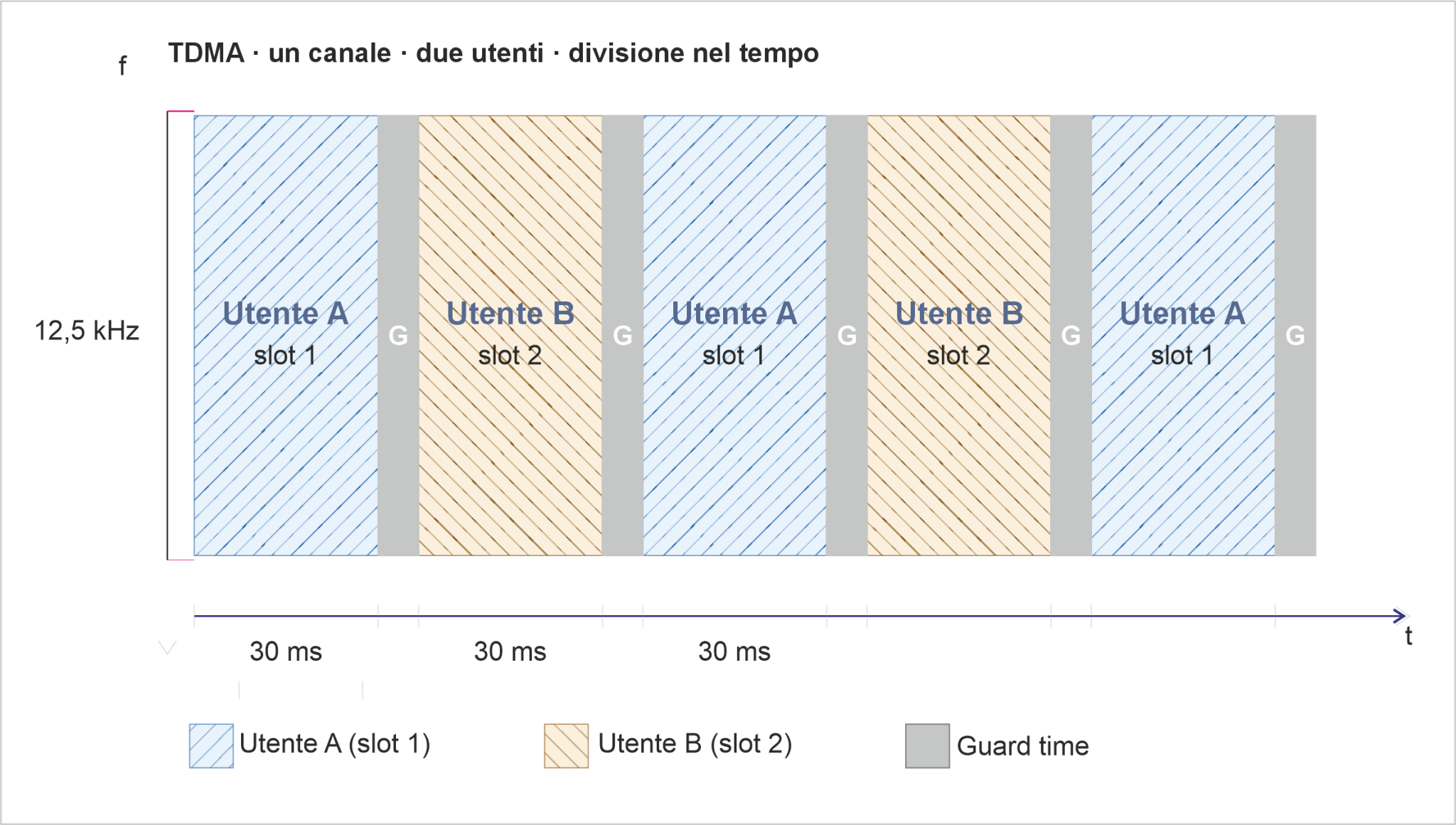
The best-known case is DMR (Digital Mobile Radio). A 12.5 kHz channel is divided into two alternating time slots of 30 ms each, each capable of carrying an independent conversation or data stream. In practice, two simultaneous QSOs coexist on the same frequency thanks to time division. Synchronization is strict: transceivers and terminals must be perfectly aligned to follow the slot sequence. A practical but often overlooked benefit is that each radio transmits only half of the time, which directly improves battery life compared to traditional analog systems.
Packet radio also introduces a form of time-based sharing, albeit less rigid. Stations transmit in packets, and protocols such as CSMA and probabilistic backoff (p-persistence) regulate channel access to avoid collisions. This is not TDMA in the strict sense, but it is still time-based channel management, where each transmission occupies a well-defined interval and others wait until the channel is free.
Systems such as D-STAR, while not TDMA, show how the time dimension is central in digital protocols: transmission is segmented into frames and packets, and repeaters handle these segments in an orderly way. This is a useful example of how temporal structure is an integral part of modern system operation.
Those working with SDR and DSP can go further, building custom TDMA systems: slots for digital voice, slots for telemetry, slots for periodic beacons, slots for remote control. It is an ideal environment for understanding how synchronization affects system performance and efficiency.
Temporal analysis with SDR
If frequency division appears on a waterfall as parallel stripes, time division appears as a rhythmic sequence of bursts, packets, and silences. A TDMA system looks like a regular pattern: short repeated transmissions, constant intervals, and precise alternation between slots. Software such as SDR#, GQRX, or GNU Radio allows precise measurement of burst duration and slot spacing, even enabling reverse engineering of unknown protocols—an activity widely practiced in the SDR community. Observing it on a waterfall is often more instructive than any theoretical explanation, because it makes the temporal structure of the protocol visible.
In summary
Time division arises from the need to let multiple streams or users share a single channel without overlap. TDM separates different streams in time; TDMA assigns time slots to independent users. Voice QSOs are a natural example of spontaneous TDMA, while systems like DMR implement strict time division, effectively doubling channel capacity. Packet radio, D-STAR, and SDR-based experimentation all show how the time dimension is central in many digital systems. Understanding TDM and TDMA means recognizing time as a resource as valuable as frequency, and learning how to exploit it to use the spectrum more efficiently and intelligently.