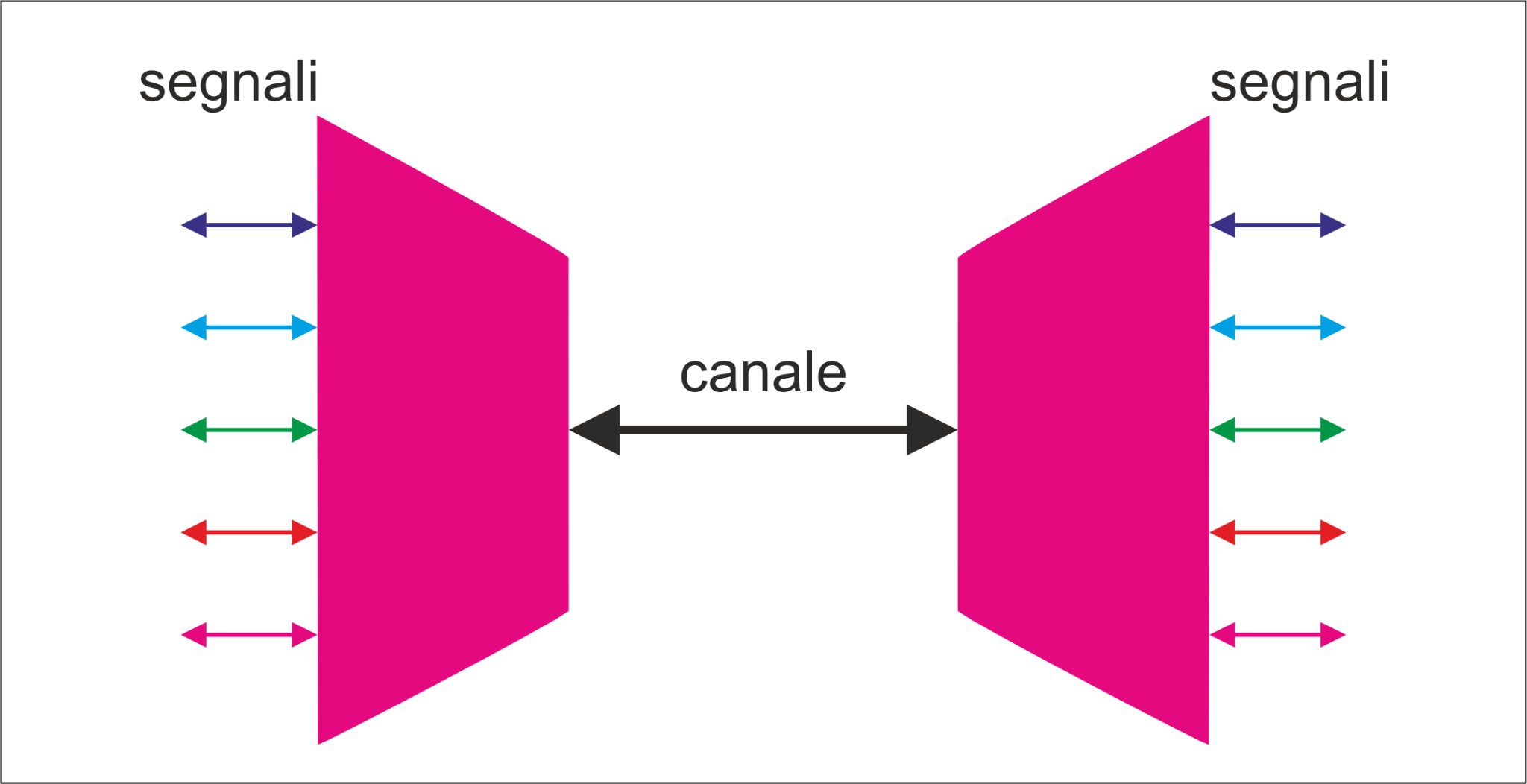
From modulation to multiplexing: changing scale
After examining how modulation works—whether AM, FM, SSB, FSK, PSK, ASK, QAM, or APSK—one might think the picture is complete: we have the techniques that allow a signal to travel over a radio channel. In reality, everything discussed so far concerns a single information stream: one signal, one carrier, one modulation shaping its form and characteristics.
But real-world communications almost never deal with just one stream. They must carry many, often simultaneously, often within the same band, sometimes even on the same frequency. This is where we move from the question how do we modulate a signal? to a more fundamental one: how do we make multiple signals coexist without interfering with each other?
This is a conceptual change of scale. Modulation defines how a single signal occupies a channel. Multiplexing defines how multiple signals share the same channel.
If modulation is the technique used to shape the carrier, multiplexing is the strategy used to organize traffic. It does not replace modulation: it relies on it. Each multiplexed stream is still modulated in some way; what changes is how multiple streams are combined.
At this point, multiplexing techniques come into play, exploiting different dimensions of the signal:
- the frequency, separating streams into distinct sub-bands;
- the time, assigning each stream a transmission slot;
- or a more sophisticated combination of both, as in modern systems based on orthogonal carriers.
For completeness, it is worth noting that there is also a fourth dimension: the code—the basis of CDMA, used in third-generation cellular networks—but it is not part of this section, as it is not currently used in amateur radio contexts.
These are different approaches to the same problem: making the most efficient use of available bandwidth to carry as much information as possible.
In the following sections, we will examine the main multiplexing techniques-FDM, TDM, and OFDM-and how they are applied both in amateur radio and in professional systems.
Understanding these techniques means completing the picture: from the shape of a single signal to the coexistence of many signals in the same radio space.
Topics in this section:
Topics: