The modulation that draws the signal
QAM is one of those ideas that, once you encounter it, makes you realize that digital modulation is not just a matter of bits and formulas, but also of geometry. It is the modulation where amplitude and phase stop being separate worlds and start working together, like two musicians improvising on the same theme. If ASK plays only with amplitude and PSK only with phase, QAM decides to use both—and it does so with surprising naturalness.
The logic of the constellation
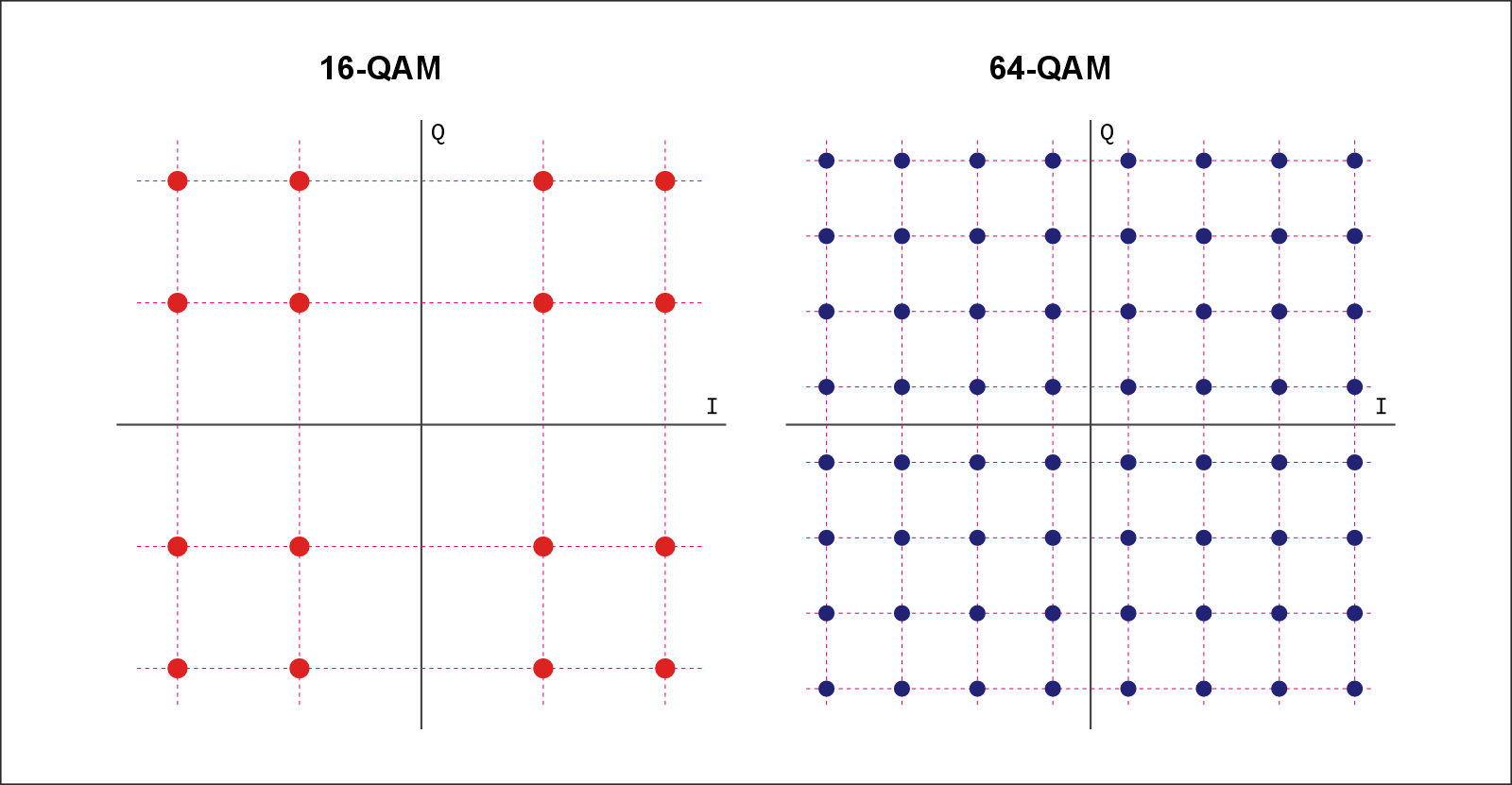
The core idea is simple: instead of choosing only how “large” the carrier should be or how much it should be rotated, QAM combines these two choices in a single gesture. Each symbol becomes a point in a plane, with its own direction and its own distance from the origin. It is as if the signal had a map, and each point on that map represented a group of bits.
At first, the constellation is small: four points at the corners of a square. That is QPSK, which is effectively identical to 4-QAM. From there the family expands: 16-QAM, 64-QAM, 256-QAM… each step increases the amount of information carried per symbol. It is a game of density: the more points you pack in, the more data you transmit—but the more precisely you must be able to distinguish them.
An ambitious modulation: lots of information, but under certain conditions
QAM is a modulation that demands a lot: high information density in a narrow bandwidth, but only if the channel is clean, the amplifier is linear, and the signal-to-noise ratio is sufficient. If the channel is good, QAM flies. If the channel is noisy, it suffers. It is a modulation that gives a lot, but also asks a lot in return.
ADSL, Wi-Fi, DVB-T, radio links
In modern communications, QAM is everywhere.
In ADSL modems, for example, each subcarrier in the DMT system is modulated with QAM, and the modem continuously adapts the constellation order to the quality of the copper line. Wi-Fi does the same in real time: it starts with simple modulations when the signal is weak, and climbs up to 256-QAM with Wi-Fi 5, 1024-QAM with Wi-Fi 6, and 4096-QAM with Wi-Fi 7 when the channel is clean.
Digital terrestrial television (DVB-T) uses 16-QAM and 64-QAM in its higher-efficiency configurations. Professional microwave links do the same: all of them rely on QAM to squeeze every last hertz of available spectrum.
QAM and radio amateurs
For shortwave listeners, it is interesting to note that DRM (Digital Radio Mondiale) broadcasts use QAM constellations (4-, 16-, and 64-QAM) applied to OFDM subcarriers. It is one of the most accessible examples of QAM “in the air” on HF.
In amateur radio, QAM is not commonly used in HF or classical digital modes, given the bandwidth constraints. But as soon as you move into microwaves, SDRs, and wideband links, it becomes a natural presence. Anyone experimenting with GNU Radio, LimeSDR, USRP, or DATV encounters it constantly: it is the modulation that enables video transmission, high-speed data, and complex data streams. It is the modulation that turns a radio link into a true broadband channel.
Watching QAM “live”
On a waterfall display, QAM does not reveal much—it looks like just another signal. The real show is in the constellation diagram.
When the channel is good, the points are tightly clustered, almost motionless. When conditions degrade, they begin to wobble, spread, and blur. It is a direct way to see noise, distortion, and amplifier compression. It is like watching the signal breathe.
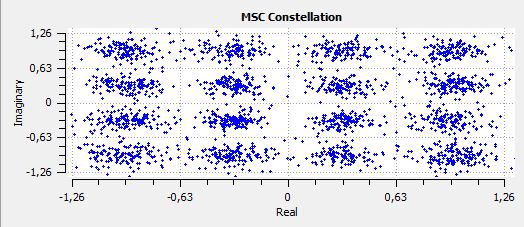
The real 16-QAM constellation of an HF DRM transmission
The limits of QAM: precision, linearity, SNR
QAM is demanding. It does not tolerate amplifiers driven into saturation, it does not handle fading particularly well, and when the signal-to-noise ratio drops too low, constellation points begin to overlap and decoding becomes uncertain. For this reason, in harsher channels, more robust modulations such as PSK or FSK—or radial constellations like APSK—are preferred.
In summary
When the channel allows it, QAM is unmatched. It is the modulation that most clearly represents the maturity of digital communications: a refined balance between efficiency and complexity, between geometry and engineering.
For a radio amateur exploring modern signal processing, understanding QAM means taking a step forward: you no longer look only at the shape of the waveform, but at the structure of the space where symbols live.
It is a modulation that does not merely carry information: it draws it.