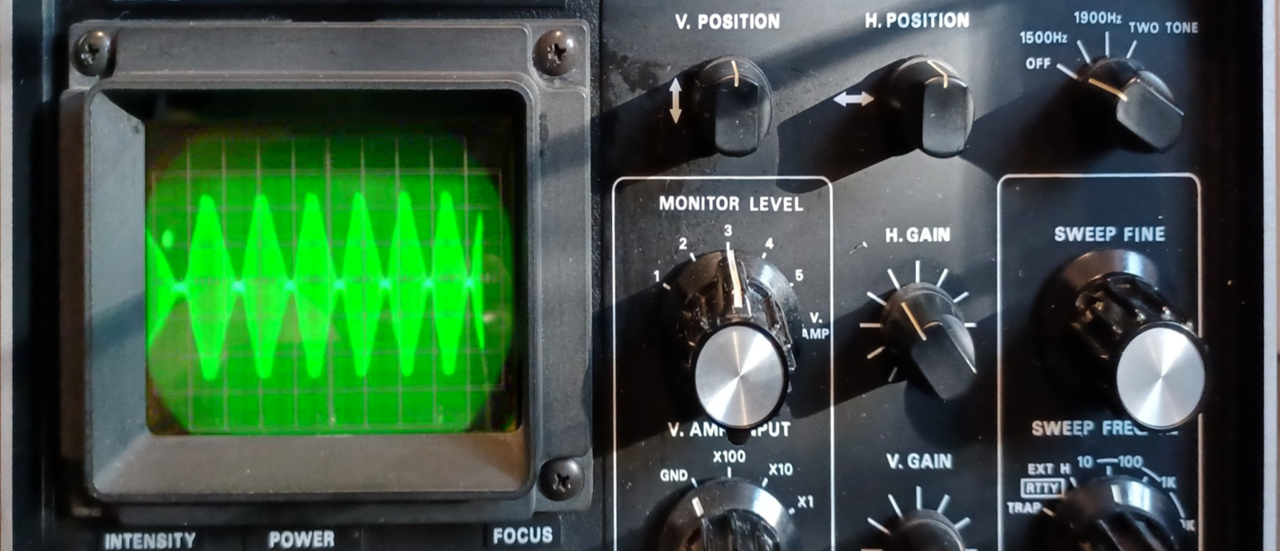
Analog communications are the starting point of the entire history of radio communications. In this context, information—typically voice or an audio signal—is transmitted by continuously varying a physical characteristic of a carrier wave, such as its amplitude or frequency. The resulting signal is a direct representation of the original phenomenon: continuous both in time and amplitude, with every variation immediately reflected in the modulation of the carrier.
This approach offers the advantage of simplicity: analog systems are relatively easy to implement, require little processing, and feature a valuable characteristic known as graceful degradation: even under non-ideal conditions, the signal remains partially intelligible, degrading progressively rather than failing abruptly. However, this simplicity comes at a cost. The transmission channel—subject to noise, interference, and distortion—directly affects the quality of the received signal. Every impairment is added to the useful information and cannot be completely removed.
Over time, several analog modulation techniques have been developed to improve efficiency and quality: from amplitude modulation (AM), simple but sensitive to interference, to frequency modulation (FM), more robust but more demanding in terms of bandwidth, and finally to single sideband (SSB), a variation of amplitude modulation that significantly optimizes spectrum and power usage by eliminating the carrier and one of the two sidebands.
These techniques form the foundation of radio communications as they were known throughout most of the twentieth century and are still widely used today, particularly in the field of amateur radio. Understanding how they work means acquiring the fundamentals needed to correctly interpret even the most modern technologies that have evolved from them.
Digital communication is built upon these foundations and represents a radical change in the way information is transmitted over radio. Unlike analog systems, where the signal is continuously variable, digital systems convert information into a discrete sequence of bits—binary symbols that numerically represent the content to be transmitted. It is worth noting that, in real-world systems, transmission often takes place using symbols that carry multiple bits simultaneously, but the underlying principle remains the same: the information is discrete, not continuous.
This transition introduces a fundamental level of abstraction: the radio channel no longer carries the original signal directly, but rather its encoded representation. Before transmission, the signal—for example, speech—is sampled, quantized, and converted into digital data. Advanced compression techniques can then be applied to reduce the amount of information that must be transmitted, along with error-correction techniques that ensure data integrity even in the presence of interference.
The result is a system that is far more efficient and robust than its analog counterpart. As long as the bits are received correctly, the signal can be reconstructed without progressive degradation. Unlike analog communication, which degrades gradually, digital communication exhibits a sharp threshold—often referred to as the cliff effect—beyond which communication suddenly becomes unusable. There is no intermediate quality level: the system either works, or it does not.
This behavior is one of the defining characteristics of digital transmissions.
However, these transmissions still physically rely on analog signals: bits travel through the real world by being modulated onto a carrier wave, and understanding how this translation takes place is precisely the subject of the pages that follow.
Topics covered in this section:
Topics: